Search This Blog

Showing posts with label Intuitionism. Show all posts

Sunday, November 28, 2010

Fine Tuning Ethical Intuitionism

There are different varieties of Ethical (or Moral or Evolutionary) Intuitionism. Some are subject to more criticism than others. I am in the process of fine tuning my particular view of Ethical Intuitionism. I found a recent article by Jeff McMahan to be quite helpful ("Moral Intuition," in The Blackwell Guide to Ethical Theory, ed. Hugh LaFollette [2000],  92-110).

1. What is a moral intuition?

According to McMahan:


[It] is a spontaneous moral judgment, often concerning a particular act or agent, though an intuition may also have as its object a type of act or, less frequently, a more general moral rule or principle. In saying a moral intuition is a spontaneous judgment, I mean that it is not the result of conscious inferential reasoning. In the first instance at least, the allegiance the intuition commands is not based on an awareness of its relations to one's other beliefs. If one considers the act of torturing the cat, one judges immediately that, in the circumstances, this would be wrong. One does not need to consult one's other beliefs in order to arrive at this judgment. This kind of spontaneity, I should stress, is entirely compatible with the possibility that a fair amount of cognitive processing may be occuring beneath the surface of consciousness (pp. 93-94).

2. There is not a special organ or faculty that perceives moral facts.

Although some have held that ethical intuitions are the deliverances of a special organ or faculty of moral perception, typically understood as something like an inner eye that provides occult access to a noumenal realm of objective values (p. 94), I reject this notion. I don't believe that there is something like a sixth sense that is able to perceive moral facts.

3. Intuitions are not infallible.

4. Intuitions are biologically based.
But numerous considerations--such as the diversity of moral intuitions, the fact that people do often doubt and even repudiate certain of their intuitions, and the evident origin of some intutitions in social prejudice or self-interest--make it untenable to suppose that intuitions are direct and infallible perceptions of morality (pp. 94-95).


5. Intuitions may differ among people.
One piece of evidence for this is the surprising uniformity of our intuitions about particular cases. We have been impressed for so long by the claims of anthropologists, English professors, undergraduates, and others about the diversity of moral opinion that we are inclined to overlook how much agreement there actually is. Interestingly, what one finds is that moral disagreements tend to widen and intensify the more we abstract from particular cases and focus instead on matters of principle or theory. When the partisans of different schools of moral thought turn their attention to particular cases, there is far more intuitive agreement that their higher-level disputes would lead one to suspect (pp. 106-07).


There are several explanations for this. One is that our moral intuitions undoubtedly stem from numerous diverse sources: while some derive from biologically programmed dispositions that are largely uniform across the species, others are the products of cultural determinants, economic or social conditions, vagaries of individual character and circumstance, and so on. Given the heterogeneity of these sources, it is hardly surprising that there are conflicts (p. 109).

Monday, October 18, 2010

"Morals Without God?" by Frans de Waal

There was an interesting article in the NY Times yesterday  (10/17/10) by Frans de Waal, the renowned primatologist, entitled: "Morals Without God." Regular readers of my blog know that I hold to a form of Ethical Intuitionism or better yet, Evolutionary Intuitionism (see the book of the same title by Brian Zamulinski).

While I certainly have not worked out all of the details of the theory to my own satisfaction, I feel that there is a strong scientific basis for this idea of moral instincts. In the NY Times article by de Wall, he states:

Charles Darwin was interested in how morality fits the human-animal continuum, proposing in “The Descent of Man”: “Any animal whatever, endowed with well-marked social instincts … would inevitably acquire a moral sense or conscience, as soon as its intellectual powers had become as well developed … as in man.” ...

Fortunately, there has been a resurgence of the Darwinian view that morality grew out of the social instincts. Psychologists stress the intuitive way we arrive at moral judgments while activating emotional brain areas, and economists and anthropologists have shown humanity to be far more cooperative, altruistic, and fair than predicted by self-interest models. Similarly, the latest experiments in primatology reveal that our close relatives will do each other favors even if there’s nothing in it for themselves.

Such findings have implications for human morality. According to most philosophers, we reason ourselves towards a moral position. Even if we do not invoke God, it is still a top-down process of us formulating the principles and then imposing those on human conduct. But would it be realistic to ask people to be considerate of others if we had not already a natural inclination to be so? Would it make sense to appeal to fairness and justice in the absence of powerful reactions to their absence? Imagine the cognitive burden if every decision we took needed to be vetted against handed-down principles. Instead, I am a firm believer in the Humean position that reason is the slave of the passions. We started out with moral sentiments and intuitions, which is also where we find the greatest continuity with other primates. Rather than having developed morality from scratch, we received a huge helping hand from our background as social animals [emphasis mine].

At the same time, however, I am reluctant to call a chimpanzee a “moral being.” This is because sentiments do not suffice. We strive for a logically coherent system, and have debates about how the death penalty fits arguments for the sanctity of life, or whether an unchosen sexual orientation can be wrong. These debates are uniquely human. We have no evidence that other animals judge the appropriateness of actions that do not affect themselves. The great pioneer of morality research, the Finn Edward Westermarck, explained what makes the moral emotions special: “Moral emotions are disconnected from one’s immediate situation: they deal with good and bad at a more abstract, disinterested level.” This is what sets human morality apart: a move towards universal standards combined with an elaborate system of justification, monitoring and punishment [emphasis mine].

See the video below for de Waal's contention that there is a biological basis for the 'golden rule.'

Thursday, September 30, 2010

Consensus Statement on The Science of Morality

It seems to me that points #2 and #3 are in harmony with the theory of Ethical Intuitionism which I have defended.


A statement of consensus reached among participants at
the Edge The New Science of Morality Conference
Washington, CT, June 20-22, 2010

1) Morality is a natural phenomenon and a cultural phenomenon

Like language, sexuality, or music, morality emerges from the interaction of multiple psychological building blocks within each person, and from the interactions of many people within a society. These building blocks are the products of evolution, with natural selection playing a critical role. They are assembled into coherent moralities as individuals mature within a cultural context. The scientific study of morality therefore requires the combined efforts of the natural sciences, the social sciences, and the humanities.

2) Many of the psychological building blocks of morality are innate

The word "innate," as we use it in the context of moral cognition, does not mean immutable, operational at birth, or visible in every known culture. It means "organized in advance of experience," although experience can revise that organization to produce variation within and across cultures.

Many of the building blocks of morality can be found, in some form, in other primates, including sympathy, friendship, hierarchical relationships, and coalition-building. Many of the building blocks of morality are visible in all human culture, including sympathy, friendship, reciprocity, and the ability to represent others' beliefs and intentions.

Some of the building blocks of morality become operational quite early in childhood, such as the capacity to respond with empathy to human suffering, to act altruistically, and to punish those who harm others.

3) Moral judgments are often made intuitively, with little deliberation or conscious weighing of evidence and alternatives

Like judgments about the grammaticality of sentences, moral judgments are often experienced as occurring rapidly, effortlessly, and automatically. They occur even when a person cannot articulate reasons for them.

4) Conscious moral reasoning plays multiple roles in our moral lives

People often apply moral principles and engage in moral reasoning. For example, people use reasoning to detect moral inconsistencies in others and in themselves, or when moral intuitions conflict, or are absent. Moral reasoning often serves an argumentative function; it is often a preparation for social interaction and persuasion, rather than an open-minded search for the truth. In line with its persuasive function, moral reasoning can have important causal effects interpersonally. Reasons and arguments can establish new principles (e.g., racial equality, animal rights) and produce moral change in a society.

5) Moral judgments and values are often at odds with actual behavior

People often fail to live up to their consciously-endorsed values. One of the many reasons for the disconnect is that moral action often depends on self-control, which is a fluctuating and limited resource. Doing what is morally right, especially when contrary to selfish desires, often depends on an effortful inner struggle with an uncertain outcome.

6) Many areas of the brain are recruited for moral cognition, yet there is no "moral center" in the brain

Moral judgments depend on the operation of multiple neural systems that are distinct but that interact with one another, sometimes in a competitive fashion. Many of these systems play comparable roles in non-moral contexts. For example, there are systems that support the implementation of cognitive control, the representation of mental states, and the affective representation of value in both moral and non-moral contexts.

7) Morality varies across individuals and cultures

People within each culture vary in their moral judgments and behaviors. Some of this variation is due to heritable differences in temperament (for example, agreeableness or conscientiousness) or in morally-relevant capacities (such as one’s ability to take the perspective of others). Some of this difference is due to variations in childhood experiences; some is due to the roles and contexts influencing a person at the moment of judgment or action.

Morality varies across cultures in many ways, including the overall moral domain (what kinds of things get regulated), as well as specific moral norms, practices, values, and institutions. Moral virtues and values are strongly influenced by local and historical circumstances, such as the nature of economic activity, form of government, frequency of warfare, and strength of institutions for dispute resolution.

8) Moral systems support human flourishing, to varying degrees

The emergence of morality allowed much larger groups of people to live together and reap the benefits of trust, trade, shared security, long term planning, and a variety of other non-zero-sum interactions. Some moral systems do this better than others, and therefore it is possible to make some comparative judgments.

The existence of moral diversity as an empirical fact does not support an "anything-goes" version of moral relativism in which all moral systems must be judged to be equally good. We note, however, that moral evaluations across cultures must be made cautiously because there are multiple justifiable visions of flourishing and wellbeing, even within Western societies. Furthermore, because of the power of moral intuitions to influence reasoning, social scientists studying morality are at risk of being biased by their own culturally shaped values and desires.

Signed by:

Roy Baumeister, Florida State University
Paul Bloom, Yale University
Joshua Greene, Harvard University
Jonathan Haidt, University of Virginia
Sam Harris, Project Reason
Joshua Knobe, Yale University
David Pizarro, Cornell University

Friday, September 10, 2010

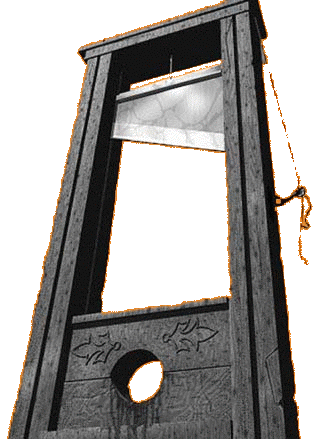
Why Hume's Guillotine Fails with regard to Ethical Intuitionism

Some theists have argued that Hume's Guillotine effectively eliminates the possiblity of there being  moral facts given a naturalistic world-view. What is Hume's Guillotine?
Hume's Guillotine, also known as the "is-ought problem" or Hume's law is a criticism of writings by ethicists who make normative claims (about what ought to be) based on positive premises (about what is). The problem was articulated by David Hume in his most important philosophical work, A Treatise of Human Nature (Book III, §I).

Hume argued that one cannot make a normative claim based on facts about the world, implying that normative claims cannot be the conclusions of reason.

The term "Hume's Guillotine" is meant to describe the severance of "is" statements from "ought" statements, which similarly, and colourfully, illustrates the resulting removal of the head from many ethical arguments.

One may consider the following moral argument as an example of an is-ought problem:

1.Sam is stealing money from work.
2.Losing money by theft causes harm to Sam's employers.
3.(One ought to not cause harm to his employers.)
4.Therefore, Sam ought to stop stealing money from work.

Premises 1 and 2 are "is" statements, describing facts of what is happening. Premise 3 and Conclusion 4 are "ought" statements, that describes how things should be happening. But what is the source of this knowledge? This argument appears to be valid if the premises are true, but unless we can logically support Premise 3, it is not sound. What can possibly give us rational knowledge that things ought to be different than the way things are?
(Philosophy-Index)

Why doesn't Hume's Guillotine effectively decapitate ethical intuitionism? Simply because ethical intuitionism holds that there are certain moral facts that are self-evident, and are not based on inference or conscious reasoning.  One definition of Ethical Intuitionism is a view in moral epistemology according to which some moral truths can be known without inference ("Ethical Intuitionism").  Hume is arguing that one cannot move from a descriptive fact (how something is) to a prescriptive fact (how something ought to be) by means of inference or deduction. However, that is not what ethical intuitionists do. Listen to Brian Zamulinski:


Inference is an intellectual movement from proposition to proposition. Apprehension is the acquisition of a belief in response to a state of affairs. Our ability to apprehend states of affairs is not fundamentally an ability to make inferences, no matter what sorts of inferences. It is an ability to see that such and such is the case. With evolutionary intuitionism, we intuitively apprehend the fact, say, that torture is wrong. We do not infer the belief that torture is wrong from other propositions. Since inference is not involved, the impossibility of inferring an "ought" from an "is" is not relevant. The is/ought gap is of no significance whatsoever for evolutionary intuitionism (Evolutionary Intuitionism: A Theory of the Origin and Nature of Moral Facts [2007], p. 112).

Wednesday, July 7, 2010

A Defense of Ethical Intuitionism--Part Five

This is the fifth in a series on Ethical Intuitionism (part one, part two, part three, and part four). In my view, moral intuitions are like axioms in mathematics. They are "givens," self-evident facts that serve as a starting point from which other statements are logically derived. One has to start somewhere. One must have certain assumptions that are deemed to be right morally before one can build a superstructure of moral theory. These "starting points," or "axioms," or "intuitions," are apparently something that we born with. We don't have to be taught them, we don't have to defend them, they are universally recognized as true or right. What does this particular theory of morals have to do with my de-conversion from evangelical Christianity? See this post for the answer.

In the last post on this topic, I mentioned the work of anthropologists Richard Shweder and Alan Fiske who surveyed people across the globe and came up with a set of moral intuitions that virtually all peoples agreed on. University of Virginia psychologist Jonathan Haidt grouped these intuitions into five categories:

1.Care for others, protecting them from harm. (He also referred to this dimension as Harm.)

2.Fairness, Justice, treating others equally.

3.Loyalty to your group, family, nation. (He also referred to this dimension as Ingroup.)

4.Respect for tradition and legitimate authority. (He also referred to this dimension as Authority.)

5.Purity, avoiding disgusting things, foods, actions.

He evaluated people's responses to the following hypotheticals:

Stick a pin into your palm.
Stick a pin into the palm of a child you don’t know. (Harm.)

Accept a wide-screen TV from a friend who received it at no charge because of a computer error.
Accept a wide-screen TV from a friend who received it from a thief who had stolen it from a wealthy family. (Fairness.)

Say something bad about your nation (which you don’t believe) on a talk-radio show in your nation.
Say something bad about your nation (which you don’t believe) on a talk-radio show in a foreign nation. (Community.)

Slap a friend in the face, with his permission, as part of a comedy skit.
Slap your minister in the face, with his permission, as part of a comedy skit. (Authority.)

Attend a performance-art piece in which the actors act like idiots for 30 minutes, including flubbing simple problems and falling down on stage.
Attend a performance-art piece in which the actors act like animals for 30 minutes, including crawling around naked and urinating on stage. (Purity.)

In each pair, the second action feels far more repugnant. Most of the moral illusions we have visited come from an unwarranted intrusion of one of the moral spheres into our judgments. A violation of community led people to frown on using an old flag to clean a bathroom. Violations of purity repelled the people who judged the morality of consensual incest and prevented the moral vegetarians and nonsmokers from tolerating the slightest trace of a vile contaminant. At the other end of the scale, displays of extreme purity lead people to venerate religious leaders who dress in white and affect an aura of chastity and asceticism
(Pinker, "The Moral Instinct").

According to Pinker, these intuitions are a result of evolutionary development. He writes:
The five spheres are good candidates for a periodic table of the moral sense not only because they are ubiquitous but also because they appear to have deep evolutionary roots. The impulse to avoid harm. . . can also be found in rhesus monkeys, who go hungry rather than pull a chain that delivers food to them and a shock to another monkey. Respect for authority is clearly related to the pecking orders of dominance and appeasement that are widespread in the animal kingdom. The purity-defilement contrast taps the emotion of disgust that is triggered by potential disease vectors like bodily effluvia, decaying flesh and unconventional forms of meat, and by risky sexual practices like incest.

The other two moralized spheres match up with the classic examples of how altruism can evolve that were worked out by sociobiologists in the 1960s and 1970s and made famous by Richard Dawkins in his book “The Selfish Gene.” Fairness is very close to what scientists call reciprocal altruism, where a willingness to be nice to others can evolve as long as the favor helps the recipient more than it costs the giver and the recipient returns the favor when fortunes reverse. The analysis makes it sound as if reciprocal altruism comes out of a robotlike calculation, but in fact Robert Trivers, the biologist who devised the theory, argued that it is implemented in the brain as a suite of moral emotions. Sympathy prompts a person to offer the first favor, particularly to someone in need for whom it would go the furthest. Anger protects a person against cheaters who accept a favor without reciprocating, by impelling him to punish the ingrate or sever the relationship. Gratitude impels a beneficiary to reward those who helped him in the past. Guilt prompts a cheater in danger of being found out to repair the relationship by redressing the misdeed and advertising that he will behave better in the future (consistent with Mencken’s definition of conscience as “the inner voice which warns us that someone might be looking”). Many experiments on who helps whom, who likes whom, who punishes whom and who feels guilty about what have confirmed these predictions.

Community, the very different emotion that prompts people to share and sacrifice without an expectation of payback, may be rooted in nepotistic altruism, the empathy and solidarity we feel toward our relatives (and which evolved because any gene that pushed an organism to aid a relative would have helped copies of itself sitting inside that relative). In humans, of course, communal feelings can be lavished on nonrelatives as well. Sometimes it pays people (in an evolutionary sense) to love their companions because their interests are yoked, like spouses with common children, in-laws with common relatives, friends with common tastes or allies with common enemies. And sometimes it doesn’t pay them at all, but their kinship-detectors have been tricked into treating their groupmates as if they were relatives by tactics like kinship metaphors (blood brothers, fraternities, the fatherland), origin myths, communal meals and other bonding rituals.
While these five moral intuitions seem to be a result of evolution, how they are applied practically depends on the sociology of the group. Pinker explains:

All this brings us to a theory of how the moral sense can be universal and variable at the same time. The five moral spheres are universal, a legacy of evolution. But how they are ranked in importance, and which is brought in to moralize which area of social life — sex, government, commerce, religion, diet and so on — depends on the culture. Many of the flabbergasting practices in faraway places become more intelligible when you recognize that the same moralizing impulse that Western elites channel toward violations of harm and fairness (our moral obsessions) is channeled elsewhere to violations in the other spheres. Think of the Japanese fear of nonconformity (community), the holy ablutions and dietary restrictions of Hindus and Orthodox Jews (purity), the outrage at insulting the Prophet among Muslims (authority). In the West, we believe that in business and government, fairness should trump community and try to root out nepotism and cronyism. In other parts of the world this is incomprehensible — what heartless creep would favor a perfect stranger over his own brother?

The ranking and placement of moral spheres also divides the cultures of liberals and conservatives in the United States. Many bones of contention, like homosexuality, atheism and one-parent families from the right, or racial imbalances, sweatshops and executive pay from the left, reflect different weightings of the spheres. In a large Web survey, Haidt found that liberals put a lopsided moral weight on harm and fairness while playing down group loyalty, authority and purity. Conservatives instead place a moderately high weight on all five. It’s not surprising that each side thinks it is driven by lofty ethical values and that the other side is base and unprincipled.

Reassigning an activity to a different sphere, or taking it out of the moral spheres altogether, isn’t easy. People think that a behavior belongs in its sphere as a matter of sacred necessity and that the very act of questioning an assignment is a moral outrage. The psychologist Philip Tetlock has shown that the mentality of taboo — a conviction that some thoughts are sinful to think — is not just a superstition of Polynesians but a mind-set that can easily be triggered in college-educated Americans. Just ask them to think about applying the sphere of reciprocity to relationships customarily governed by community or authority. When Tetlock asked subjects for their opinions on whether adoption agencies should place children with the couples willing to pay the most, whether people should have the right to sell their organs and whether they should be able to buy their way out of jury duty, the subjects not only disagreed but felt personally insulted and were outraged that anyone would raise the question.
This series to be continued.

Tuesday, July 6, 2010

A Defense of Ethical Intuitionism--Part Four

This is the fourth in a series on Ethical Intuitionism (part one, part two, and part three). In my view, moral intuitions are like axioms in mathematics. They are "givens," self-evident facts that serve as a starting point from which other statements are logically derived. One has to start somewhere. One must have certain assumptions that are deemed to be right morally before one can build a superstructure of moral theory. These "starting points," or "axioms," or "intuitions," are apparently something that we born with. We don't have to be taught them, we don't have to defend them, they are universally recognized as true or right. What does this particular theory of morals have to do with my de-conversion from evangelical Christianity? See this post for the answer.

While Christians would argue that these moral intuitions were implanted by God, I think that there is growing evidence that they are a result of evolution. Steven Pinker, Professor of Psychology at Harvard University and formerly a Professor in the Department of Brain and Cognitive Sciences at MIT, argues for this in a New York Times article entitled, "The Moral Instinct" (Jan. 13, 2008).

1. We are born with a "moral grammar."

Pinker refers to Noam Chomsky, professor emeritus of linguistics at the Massachusetts Institute of Technology, who argues that:

we are born with a “universal grammar” that forces us to analyze speech in terms of its grammatical structure, with no conscious awareness of the rules in play. By analogy, we are born with a universal moral grammar that forces us to analyze human action in terms of its moral structure, with just as little awareness.

2. This "moral grammar" is present in young children.

Research shows that these instincts are present in very young children (see the work of Paul Bloomof The Infant Cognition Center at Yale University). According to Pinker:

The stirrings of morality emerge early in childhood. Toddlers spontaneously offer toys and help to others and try to comfort people they see in distress. And according to the psychologists Elliot Turiel and Judith Smetana, preschoolers have an inkling of the difference between societal conventions and moral principles. Four-year-olds say that it is not O.K. to wear pajamas to school (a convention) and also not O.K. to hit a little girl for no reason (a moral principle). But when asked whether these actions would be O.K. if the teacher allowed them, most of the children said that wearing pajamas would now be fine but that hitting a little girl would still not be.

3. There is a neurological basis for this "moral grammar."

The instinctive knowledge of basic right and wrong seems to be a result of how a normal human brain functions. Pinker writes:

Though no one has identified genes for morality, there is circumstantial evidence they exist. The character traits called “conscientiousness” and “agreeableness” are far more correlated in identical twins separated at birth (who share their genes but not their environment) than in adoptive siblings raised together (who share their environment but not their genes). People given diagnoses of “antisocial personality disorder” or “psychopathy” show signs of morality blindness from the time they are children. They bully younger children, torture animals, habitually lie and seem incapable of empathy or remorse, often despite normal family backgrounds. Some of these children grow up into the monsters who bilk elderly people out of their savings, rape a succession of women or shoot convenience-store clerks lying on the floor during a robbery.

Though psychopathy probably comes from a genetic predisposition, a milder version can be caused by damage to frontal regions of the brain. The neuroscientists Hanna and Antonio Damasio and their colleagues found that some children who sustain severe injuries to their frontal lobes can grow up into callous and irresponsible adults, despite normal intelligence. They lie, steal, ignore punishment, endanger their own children and can’t think through even the simplest moral dilemmas, like what two people should do if they disagreed on which TV channel to watch or whether a man ought to steal a drug to save his dying wife. The moral sense, then, may be rooted in the design of the normal human brain.

4. Anthropologists have found common moral instincts in virtually all people.

When anthropologists like Richard Shweder and Alan Fiske survey moral concerns across the globe, they find that a few themes keep popping up from amid the diversity. People everywhere, at least in some circumstances and with certain other folks in mind, think it’s bad to harm others and good to help them. They have a sense of fairness: that one should reciprocate favors, reward benefactors and punish cheaters. They value loyalty to a group, sharing and solidarity among its members and conformity to its norms. They believe that it is right to defer to legitimate authorities and to respect people with high status. And they exalt purity, cleanliness and sanctity while loathing defilement, contamination and carnality.

In the next post in this series, I will examine these common moral instincts of mankind more thoroughly.

Tuesday, June 29, 2010

A Defense of Ethical Intuitionism--Part Three

This is the third in a series on Ethical Intuitionism (part one and part two). In my view, moral intuitions are like axioms in mathematics. They are "givens," self-evident facts that serve as a starting point from which other statements are logically derived. One has to start somewhere. One must have certain assumptions that are deemed to be right morally before one can build a superstructure of moral theory. These "starting points," or "axioms," or "intuitions," are apparently something that we born with. We don't have to be taught them, we don't have to defend them, they are universally recognized as true or right. Where do these "intuitions" come from? That is a hard question. Christians would say they come from God. He implanted them in us when he created us in his image.  Others would argue that these intuitions have become part of our brains through evolution. In that sense, they are something like instincts.

I came across a very interesting article in the New York Times "The Moral Instinct" (Jan. 13, 2008), by Steven Pinker , a Professor of Psychology at Harvard University and formerly a Professor in the Department of Brain and Cognitive Sciences at MIT.

Pinker discusses research which seems to show that our moral instincts or intuitions are a result of evolution. He writes:

Today, a new field is using illusions to unmask a sixth sense, the moral sense. Moral intuitions are being drawn out of people in the lab, on Web sites and in brain scanners, and are being explained with tools from game theory, neuroscience and evolutionary biology.

. . . The human moral sense turns out to be an organ of considerable complexity, with quirks that reflect its evolutionary history and its neurobiological foundations.
1. Moral intuitions are different than moral opinions.

The starting point for appreciating that there is a distinctive part of our psychology for morality is seeing how moral judgments differ from other kinds of opinions we have on how people ought to behave. Moralization is a psychological state that can be turned on and off like a switch, and when it is on, a distinctive mind-set commandeers our thinking. This is the mind-set that makes us deem actions immoral (“killing is wrong”), rather than merely disagreeable (“I hate brussels sprouts”), unfashionable (“bell-bottoms are out”) or imprudent (“don’t scratch mosquito bites”).
2. Moral intuitions are felt to be universally true.

The first hallmark of moralization is that the rules it invokes are felt to be universal. Prohibitions of rape and murder, for example, are felt not to be matters of local custom but to be universally and objectively warranted. One can easily say, “I don’t like brussels sprouts, but I don’t care if you eat them,” but no one would say, “I don’t like killing, but I don’t care if you murder someone.”

3. Violations of moral intuitions are felt to be worthy of punishment.

The other hallmark is that people feel that those who commit immoral acts deserve to be punished. Not only is it allowable to inflict pain on a person who has broken a moral rule; it is wrong not to, to “let them get away with it.” People are thus untroubled in inviting divine retribution or the power of the state to harm other people they deem immoral. Bertrand Russell wrote, “The infliction of cruelty with a good conscience is a delight to moralists — that is why they invented hell.”
4. Moral intuitions sometimes cannot be explained rationally.

Pinker cites an example from psychologist Jonathan Haidt:

Julie is traveling in France on summer vacation from college with her brother Mark. One night they decide that it would be interesting and fun if they tried making love. Julie was already taking birth-control pills, but Mark uses a condom, too, just to be safe. They both enjoy the sex but decide not to do it again. They keep the night as a special secret, which makes them feel closer to each other. What do you think about that — was it O.K. for them to make love?
Most people will have a moral intuition that a brother and sister engaging in sex is wrong. But why?

In the case of Julie and Mark, people raise the possibility of children with birth defects, but they are reminded that the couple were diligent about contraception. They suggest that the siblings will be emotionally hurt, but the story makes it clear that they weren’t. They submit that the act would offend the community, but then recall that it was kept a secret. Eventually many people admit, “I don’t know, I can’t explain it, I just know it’s wrong.”
5. Apparently our brain has evolved to find certain behaviors instinctively wrong.

The idea that the moral sense is an innate part of human nature is not far-fetched. A list of human universals collected by the anthropologist Donald E. Brown includes many moral concepts and emotions, including a distinction between right and wrong; empathy; fairness; admiration of generosity; rights and obligations; proscription of murder, rape and other forms of violence; redress of wrongs; sanctions for wrongs against the community; shame; and taboos. . . . The moral sense, then, may be rooted in the design of the normal human brain.
It could be that because incestuous relationships produce genetically inferior children, and are therefore counter-productive to human evolution, our brains have evolved to find that behavior instinctively wrong. Other moral instincts would also be derived from whether the actions under consideration were productive or counter-productive to human evolution.

We will examine this issue further in a future post.

Monday, June 28, 2010

A Defense of Ethical Intuitionism--Part Two

In part one of a defense of Ethical Intuitionism, I discussed what an intuition is, what some examples of intuitionism are, and whether intuitions are just derived from antecedent moral beliefs. I gave two ethical questions from Michael Huemer's book, Ethical Intuitionism:

Example 1: A doctor in a hospital has five patients who need organ transplants; otherwise, they will die. They all need different organs. He also has one healthy patient, in for a routine checkup, who happens to be compatible with the five. Should the doctor kill the healthy patient and distribute his organs to the other five?

Example 2: A runaway trolley is heading for a fork in the track. If it takes the left fork, it will collide with and kill five people; if it takes the right fork, it will collide with and kill one person. None of the people can be moved out of the way in time. There is a switch that determines which fork the trolley takes. It is presently set to send the trolley to the left. You can flip the switch, sending the trolley to the right instead. Should you flip the switch
(p. 103)?

I think most people would instinctively answer "no" to the first question and "yes" to the second. Why is that, since answering "yes" to both questions would end up saving five lives while sacrificing one? Moral philosophers who hold a utilitarian approach to ethics would be inclined to answer "yes" to question 1 even though they admit it seems counter-intuitive. It could be that in the case of question 2, it is inevitable that someone(s) is going to die and that it is better for one to die than five is intuitive. Things might change if the five people on the other track are all adults and the one on the other track is a child. It might also change if one knew the one person and loved that person but the five on the other track were strangers. However, I think in that case a person's instinct is to save his loved one. Many factors could come into play but the point is that whatever decision that is made is made in an instant and is not based on moral reflection. As Huemer says: The point is that no moral theory held prior to considering cases such as those above is likely to afford us an explanation for why the sacrifice should be found unacceptable in example 1 but acceptable in example 2 (p. 103).

1. Are some moral intuitions stronger than others?

Yes, for example, let's change the scenario in example two. On one side of the track is five people and on the other side is no one. Should you flip the switch? I think 100% of people would say "yes." Why? Because to save human life is instinctive. As Huemer writes:
Not all intuitions are equal--some are more credible than others. As the above remarks suggest, one reason for this is that some intuitions are simply stronger, or more clearly seem true, than others. Another reason is that some intuitions are more widely shared than others; other things being equal, an intuition that many disagree with is more likely to be an error than is an intuition that nearly everyone shares. Another reason is that some intuitions have simpler contents than others, and are therefore less prone to error. And there are various reasons why some kinds of intuitions may be more open to bias than others. These facts point to the conclusion that intuitions should not be embraced uncritically, and that conflicting intuitions should be weighed against each other taking into account our best judgments as to their relative levels of reliability (p. 104).

2. Are moral intuitions objective?

It depends on how one defines "objective." If one defines it as, having reality independent of the mind, then, I don't think anything can be known to be truly objective. Since each individual is a subject, and must subjectively experience the physical world, and since the only way we as subjects comprehend anything we experience in the world is via our minds, then how can any knowledge be other than subjective?

However, by sharing their comparable experiences intersubjectively, individuals may gain an increasingly accurate understanding of the world. In this way, many different subjective experiences can come together to form intersubjective ones that are less likely to be prone to individual bias or gaps in knowledge ("Intersubjective verifiability", Wikipedia). Intersubjectivity is a term used in philosophy, psychology and sociology to describe a condition somewhere between subjectivity and objectivity, one in which a phenomenon is personally experienced (subjectively) but by more than one subject ("Intersubjectivity," Wikipedia). If virtually everyone agrees in their interpretation of an experience, then there is a high probability that the meaning given to the phenomenon is "objective." That is why, for example, several eyewitnesses who all agree are considered more reliable than one eyewitness. However, the "objectivity " suggested would still be theoretical, since no one can "get outside" of their own mind.

Thus, if virtually everyone agrees that it is wrong to do a particular thing, one can consider it to be virtually an objective moral fact that it is wrong to do the particular thing. Therefore, in that sense of "objective," one can consider moral intuitions to be "objective."

In the next post on this series I will discuss misunderstandings of ethical intuitionism.

Friday, June 18, 2010

A Defense of Ethical Intuitionism--Part One

I have identified myself as holding to the moral theory known as "Ethical Intuitionism." Michael Huemer, in his book Ethical Intuitionism, recognizes three components to this theory:
(i) there are objective moral truths; (ii) we know some of these truths through a kind of immediate, intellectual awareness, or “intuition”; and (iii) our knowledge of moral truths gives us reasons for action independent of our desires.

I have explained in a prior post how that my belief in ethical intuitionism relates to my de-conversion. Essentially, I see the God of the Bible violating a number of ethical principles. If the Bible is accurate in its reports, then the God of the Bible is an unethical being. He is not holy and righteous and he is not worthy of worship. I actually don't think such a God really exists. I think he is the invention of the imagination of ancient peoples. However, if one wants to retain evangelical Christianity, one has to explain how the actions of the God reported in the Bible are ethical inspite of our intuitions to the contrary.

1. What is an intuition?

Huemer writes:
Reasoning sometimes changes how things seem to us. But there is also a way things seem to us prior to reasoning; otherwise, reasoning could not get started. The way things seem prior to reasoning we may call an 'initial appearance'. An initial, intellectual appearance is an 'intuition'. . . . An ethical intuition is an intuition whose content is an evaluative proposition (p. 101).

2. What are some examples of ethical intuitions?

[1] Enjoyment is better than suffering.

[2] If A is better than B and B is better than C, then A is better than C.

[3] It is unjust to punish a person for a crime he did not commit.

[4] Courage, benevolence, and honesty are virtues.

[5] If a person has a right to do something, then no person has a right to forcibly prevent him from doing that thing (p. 102).

Huemer explains:

Prior to entertaining arguments for or against them, each of these propositions seems true. In each case, the appearance is intellectual; you do not perceive that these things are the case with your eyes, ears, etc. And they are evaluative. So the relevant mental states are ethical intuitions (p. 102).

3. What are examples of ethical claims that are not intuitive?

[1] The United States should not have gone to war in Iraq in 2003.

[2] We should privatize Social Security.

[3] Abortion is wrong
(p. 102).

Huemer states: Though these propositions seem true to some, the relevant appearances do not count as 'intuitions' because they depend on other beliefs (p. 102).

4. Aren't ethical intuitions just dervied from our antecedent moral beliefs?

A more sophisticated worry is that what we think of as intuitions may be products of antecedently existing beliefs, perhaps via subconscious inferences. Perhaps 'Enjoyment is better than suffering' only seems true to me because I already believe it, or believe things from which it follows (p. 103).

Huemer gives two reasons for rejecting the idea that ethical intuitions are based on antecedent moral beliefs:


First, the view that intuitions are or are caused by beliefs fails to explain the origin of our moral beliefs. Undoubtedly some moral beliefs are accounted for by inference from other moral beliefs. But since no moral belief can be derived from wholly non-moral premises [Hume's Guillotine], we must start with some moral beliefs that are not inferred from any other beliefs. Where do these starting moral beliefs come from? Do we just adopt them entirely arbitrarily? No; this is not the phenomenology of moral belief. We adopt fundamental moral beliefs because they seem right to us; we don't select them randomly.

Second, moral intuitions are not in general caused by antecedent moral beliefs, since moral intuitions often either conflict with our antecedently held moral theories, or are simply unexplained by them. Here are two famous hypothetical examples from the ethics literature:


Example 1: A doctor in a hospital has five patients who need organ transplants; otherwise, they will die. They all need different organs. He also has one healthy patient, in for a routine checkup, who happens to be compatible with the five. Should the doctor kill the healthy patient and distribute his organs to the other five?

Example 2: A runaway trolley is heading for a fork in the track. If it takes the left fork, it will collide with and kill five people; if it takes the right fork, it will collide with and kill one person. None of the people can be moved out of the way in time. There is a switch that determines which fork the trolley takes. It is presently set to send the trolley to the left. You can flip the switch, sending the trolley to the right instead. Should you flip the switch (p. 103)?

What does your intuition tell you is the correct action in each case? Remember that your intuition is your initial "gut reaction" before reflection. Does your view of what is the correct action change upon further reflection?

We will examine this in more detail in a future post.

Monday, June 14, 2010

What Does Ethical Intuitionism have to do with my De-Conversion?

In yesterday's post I identified myself as holding to "ethical intuitionism." One may wonder what that has to do with my de-conversion from evangelical Christianity. Well, it is related in this way. One of the major problems that I have with evangelical Christianity is the idea that an innocent person, Jesus of Nazareth, suffered and died in the place of sinners so that they might be forgiven. The notion of punishing an innocent person, I find intuitively to be wrong and unjust. Thus, how could man's redemption be based on an act that is itself intrinsically unjust?

While, I believe now that our moral intuitions come from our evolutionary development, when I was an evangelical Christian, I would have argued that they come from being made in the image of God. Evangelicals themselves teach that they do. Paul taught that they do in Romans 2:14-15:
Indeed, when Gentiles, who do not have the law, do by nature things required by the law, they are a law for themselves, even though they do not have the law, since they show that the requirements of the law are written on their hearts (emphasis added), their consciences also bearing witness, and their thoughts now accusing, now even defending them (NIV).

Paul is making this argument because he says that those who have never heard or seen the written law are still guilty for breaking it (Rom. 2:12).

Thus, if the moral law of God is implanted into man as Paul and evangelical Christianity claims, and if that moral law tells us that it is wrong to punish an innocent person, and God punishes an innocent person, then God has violated his own law.

One would have to conclude that either 1) the moral intuition that it is wrong to punish another person is mistaken or, 2) God's law does not apply to himself.

The problem with #1 is that it is virtually universally held that it is wrong to punish an innocent person for what someone else has done. While I have had some people dispute this in the comment section, I have never seen one example in which a judge or magistrate allowed a substitute to suffer the penalty owed by the guilty party. It just strikes us as wrong. The injustice of it is present even in the smallest child. Try punishing one of your children for what his or her sibling did (of which the former is completely innocent). I am sure you will get a cry of protest and rightly so. If the innocent child volunteered to be punished in the place of his or her sibling, that would be noble, but it would not serve the purpose of justice. The parent who punished the innocent child, even though he or she volunteered, would be committing an act of injustice.

The problem with #2 is that if the law does not apply to God, then it must be an amoral matter. In other words, if God is perfectly righteous, he could not commit an act that is immoral. If punishing an innocent is an amoral matter, then the entire law of God is amoral and thus useless as a standard of morality. The law would simply reflect what God orders man to do but would not reflect true or objective morality.

So, I conclude that the idea of the atonement (penal substitutionary theory), which is widely held in evangelical Christianity cannot be true.

Sunday, June 13, 2010

Ethical Intuitionism--The Intuition that it is Wrong to Kill

In the comments section of several posts I have identified myself as holding to a form of "ethical intuitionism." Michael Huemer, in his book, Ethical Intuitionism sees three points in the theory:
(i) there are objective moral truths; (ii) we know some of these truths through a kind of immediate, intellectual awareness, or “intuition”; and (iii) our knowledge of moral truths gives us reasons for action independent of our desires.
I don't intend to defend the theory in this post in terms of analytical arguments but rather to illustrate the truth of the theory from the practical cases of soldiers who have difficulty killing.

S.L.A. Marshall (1900 – 1977) was a chief U.S. Army combat historian during World War II and the Korean War. He wrote:

It is, therefore, reasonable to believe that the average and healthy individual--the man who can endure the mental and physical stresses of combat--still has such an inner and usually unrealized resistance to killing a fellow man that he will not of his own volition take life if it is possible to turn away from the responsibility. Though it is improbable that he may ever analyze his own feelings so searchingly as to know what is stopping his own hand, his hand is nonetheless stopped At the vital point, he becomes a conscientious objector, unknowing (Men Against Fire: The Problem of Battle Command, 1947, p. 79).

Contrary to depictions in most movies many soldiers have difficulty actually killing another human being and when they do kill a person, they often feel guilty. I think this illustrates the truth of ethical intuitionism. Even though one may be able to defend rationally that the killing was justified, one may still feel intuitively that it was wrong.

I think that most men will not kill (apart from the instinct of self-defense) unless they feel that a higher authority has authorized it, whether that authority be their country or their god. They need something to justify in their minds going against what their intuition tells them. Men are especially haunted by killing innocents or non-combatants.

The following documentary is powerful. I highly suggest you take the 25 minutes to watch it. I personally have several family members who have been in Iraq and Afghanistan and who are suffering some of the pain that is discussed in this film.

By the way, I am not interested in discussing the politics of the war. There are other forums for that. I am interested in the moral aspects and how individual soldiers deal with violating their intuition that its wrong to kill another human being.

The film is entitled: Soldiers of Conscience and I am posting only part one as it is the part that is most relevant to my discussion of "ethical intuitionism."