Search This Blog

Showing posts with label The Christian Delusion. Show all posts

Thursday, May 27, 2010

The Christian Delusion: Chapter Fourteen--Atheism Was Not The Cause Of The Holocaust

In chapter 14 of the book, The Christian Delusion (ed. John Loftus), Hector Avalos returns to deal with one of the arguments often put forward by Christians, namely, that atheist regimes have been responsible for killing many more people than Christian groups ever have. One of the more recent Christians to make that argument is Dinesh D’Souza in his book, What’s So Great About Christianity. In this chapter entitled, "Atheism Was Not The Cause Of The Holocaust," Avalos demolishes D’Souza’s arguments and exposes his sloppy scholarship.

With regard to the violence under Communist regimes, particularly the one of Josef Stalin, Avalos writes:
Most of Stalinist violence resulted from forced collectivization, and recently published documents show the complicity of church authorities in the Stalinist agenda. . . . Moreover, communism, in the sense of a system of collectivized property, is a biblical notion found already in Acts 4:32-37. That Christian communist system also results in the killing of a married couple (Acts 5:1-11) that reneged on their promise to surrender their property. Thus, the principle of killing those who did not conform to collectivization of property is already a biblical one (pp. 368-69).
The truth is that Stalin's violence, as well as that of the Maoist regime in China and other communist governments, had much more to do with their need to harness power and control of their countries than it did with their atheism.

Another argument put forth by D’Souza is that atheism is far worse than Christianity due to the much larger numbers killed under atheistic regimes. Avalos responds: But if, as D’Souza seems to think, genocide is always evil, then the numbers don’t matter as much as does the principle. If D’Souza does not think that genocide is always evil, then he is no less a moral relativist than atheists, and now we would have only his arbitrary reasons for justifying it (p. 371). A murderer's crime is not mitigated by the fact that he only killed one person instead of more. In addition, Avalos points out that the numbers are irrelevant anyway because the goal of Christians in some instances was to kill all they could find of a particular group. The fact that they were only able to round-up a certain number does not impact the immorality of their action. Avalos says: Consider that by D’Souza’s admission, Christian witch-hunts killed some 100,000 persons in Europe. . . . we might have had 10 million witches killed if witch-hunters had managed to find and kill that many. (p. 371).

Another favorite claim of Christian apologists, such as D’Souza, is that the Nazi regime under Hitler was anti-religious and its atrocities were influenced by Darwinism and atheism. This is simply false as Avalos shows. Hitler’s own writings demonstrate that he was influenced, not by atheism nor even Darwinism, but by Christianity in his desire to exterminate the Jews. Avalos cites the Catholic historian Jose Sanchez: “There is little question that the Holocaust had its origin in the centuries-long hostility felt by Christians against Jews” (Pius XII and the Holocaust, p. 70, cited by Avalos, p. 372).

In an especially damning revelation, Avalos shows how Hitler’s plan against the Jews models precisely the plan that Martin Luther, the German Reformer, had enunciated in 1543 (On the Jews and Their Lies).

Luther wrote:
What shall we Christians do with this rejected and condemned people, the Jews? . . . I shall give you my sincere advice:

First, to set fire to their synagogues or schools and to bury and cover with dirt whatever will not burn, so that no man will ever again see a stone or cinder of them. This is to be done in honor of our Lord and of Christendom, so that God might see that we are Christians, and do not condone or knowingly tolerate such public lying, cursing, and blaspheming of his Son and of his Christians. . . .

Second, I advise that their houses also be razed and destroyed. . . .

Third, I advise that all their prayer books and Talmudic writings, in which such idolatry, lies, cursing, and blasphemy are taught, be taken from them.

Fourth, I advise that their rabbis be forbidden to teach henceforth on pain of loss of life and limb. . . .

Fifth, I advise that safe-conduct on the highways be abolished completely for the Jews.

Sixth, I advise that usury be prohibited to them, and that all cash and treasure of silver and gold be taken from them and put aside for safekeeping. . . .

Seventh, I recommend putting a flail, an ax, a hoe, a spade, a distaff, or a spindle into the hands of young, strong Jews and Jewesses and letting them earn their bread in the sweat of their brow, as was imposed on the children of Adam (Gen. 3 [:19]).
(cited by Avalos, pp. 372-73).
As Avalos points out: Every single point in Luther’s plan was implemented by Nazi policy. In Mein Kampf (trans. Ralph Manheim, 1971, p. 213 cited by Avalos, p. 373), Hitler called Luther one of the greatest men who ever lived, hardly what one would expect an atheist to say.

Avalos quotes Guenter Lewy, the famed Holocaust historian, “Hitler was merely doing what the Church had done for 1,500 years” (The Catholic Church and Nazi Germany, p. 51 cited by Avalos, p. 375). Avalos adds: Hitler simply had much better logistics and technology to do what some Medieval Christians wanted to do to the Jews (p. 375). In Mein Kampf, Hitler wrote: Hence today I believe that I am acting in accordance with the will of the Almighty Creator; by defending myself against the Jews, I am fighting for the work of the Lord (p. 65 cited by Avalos, p. 375).

Avalos cites a report that as of 1938, the Nazi SS was made up of 51.4% Catholic, 22.7% Protestant and 25.7% God-believers (Richard Steigmann-Gall, The Holy Reich: Nazi Conceptions of Christianity, 1919-1945, p. 221 cited by Avalos, p. 376). That would leave less than 2/10th's of one percent who did not believe in God.

Avalos also refutes the claim that Hitler’s genocides were motivated by Darwinism. He says that Darwinism taught “natural selection,” whereas, Hitler practiced “artificial selection” (p. 387). Mein Kampf reveals that Hitler’s racist attitudes came from his understanding of the Bible not from Darwin. Hitler wrote: “. . . it is one of those concerning which it is said with such terrible justice that the sins of the fathers are avenged down to the tenth generation . . . Blood sin and desecration of the race are the original sin in this world . . .” (p. 249, cited by Avalos, p. 387).

Where did Hitler derive this idea? From the Bible, specifically Deut. 23:2-3:
No one born of a forbidden marriage nor any of his descendants may enter the assembly of the Lord, even down to the tenth generation. No Ammonite or Moabite or any of his descendants may enter the assembly of the Lord, even down to the tenth generation (see also Ezra 9:1-12).
Thus, Avalos shows conclusively that Hitler’s motivation to kill the Jews came from Christian sources. To claim, as many Christian apologists do, that Hitler’s atrocities were due to atheism or Darwinism is completely contradicted by the historical evidence.

Friday, May 21, 2010

The Christian Delusion: Chapter Thirteen--Christianity Does Not Provide the Basis for Morality

In chapter 13 of The Christian Delusion: Why Faith Fails, anthropologist David Eller returns to deal with one of the stock arguments that theists put forward, namely, that without a God, there can be no basis for morality. His essay is entitled, "Christianity Does Not Provide the Basis for Morality."

He begins by saying,
Imagine someone said to you that English provided the only basis for grammar. After you overcame your shock, you would respond that English is certainly not the only language with a grammar. You would add that grammar is not limited to language: understood broadly as rules for combination and transformation, many phenomena have a grammar, from sports to baking. Nor is grammar the sole or essential component of language: language also includes sound systems, vocabularies, and genres and styles of speech. And you would remind the speaker that grammar does not depend on human language at all: some species including chimps and parrots can produce grammatical—that is, orderly and rule-conforming—short sentences. Ultimately, you would want to explain that English does not “provide a basis” for grammar at all but rather represents one particular instance of grammar. English grammar is definitely not the only grammar in the world and even more definitely not the “real” grammar.

The person who utters a statement like “English provides the only basis for grammar” either understands very little about English (and language in general) or grammar or is expressing his/her partisanship about language (i.e. pro-English)—or more likely both. Thus, the person who utters a statement like “Christianity provides the only basis for morality” either understands very little about Christianity (or religion in general) or morality or is expressing his/her partisanship about religion (i.e. pro-Christianity)—-more likely both. But as a savvy responder you would answer that Christianity is certainly not the only religion with morality. You would add that morality is not limited to religion: understood broadly as standards for behavior, many phenomena have a morality, from philosophy to business. Nor is morality the sole or essential component of religion: religion also includes myths, rituals, and roles and institutions of behavior. And you would remind the speaker that morality does not depend on human religion at all: some non-human species demonstrate moral—-that is, orderly and standard-conforming—behavior. Ultimately, you would want to explain that Christianity does not “provide a basis” for morality at all but rather represents one particular instance of morality. Christian morality is definitely not the only morality in the world and even more definitely not the “real” morality.
(pp. 347-48).
What is morality? Eller quotes Michael Shermer: "right and wrong thoughts and behaviors in the context of the rules of a social group" (The Science of Good and Evil, p. 7). What this terse statement reminds us is that (1) morality always refers back to a set of rules and (2) each social group may have its own set of such rules(p. 352).

Why do humans have moral principles?
Because we, as an inherently social species, are necessarily interested in the actions and intentions of other members of our group (which may include, we now realize, non-human agents as well). Therefore, we need to evaluate each other’s behavior—to be able to determine the meaning of that behavior, the intention of that behavior, and the predictability of that behavior. Indeed, the very existence of society depends on, one might even say is, a shared set of standards for the interpretation, evaluation, and prediction of behavior(p. 352).
Morality is ultimately nothing more than a special case of the more general human predilection to appraise behavior and to erect systems and standards of appraisal (p. 353).
“Morality” is one entry in the universe of appraisal-talk, of which there are many other entries. What I mean is that “moral” and “immoral” are two labels that can be attached to behaviors depending on their conformity to group standards. But there are other labels too, available to members to praise or denounce (and hopefully affect and control) behavior: legal/illegal, sane/insane, mature/immature, normal/abnormal, polite/impolite, ethical/unethical, professional/unprofessional, and so on. None of these other pairs of terms quite overlaps (p. 353).
Different societies have different moral standards, for example,
most Westerners do not regard the display of a woman’s face or arms to be a moral concern at all, and some tribes like the Warlpiri or the Yanomamo did not regard public nakedness to be a moral concern. The Jains consider eating vegetables or killing insects to be a moral problem, while the average Westerner does not (pp. 353-54).
How do societies develop their moral standards (i.e., what they approve of and what they disapprove of)? They develop them based on how they believe their group can best function so as to survive and grow and have stability and order. The actual moral rules grow out of what Michael Shermer calls premoral sentiments: attachment and bonding, cooperation and mutual aid, sympathy and empathy, direct and indirect reciprocity, altruism and reciprocal altruism, conflict resolution and peacemaking, deception and deception detection, community concern and caring about what others think about you, and awareness of and response to the social rules of the group (The Science of Good and Evil, p. 31 cited by Eller, p. 354).

In order to give more authority to the standards, societies have typically tied them to their particular religion, thus giving them divine authority.

Just as religions have different beliefs, they also have different standards of behavior. In orthodox Judaism, what one can and cannot eat is a moral matter. In many forms of Islam, it is morally wrong for a woman to show her face in public. In Hinduism, the moral standards differ based on the particular caste to which a person belongs:if one is pariah, one’s moral duty is to perform dirty jobs, and if one is kshatriya one’s moral duty is to lead, to fight, to kill, and to die (p. 357). In Buddhism, one is to follow the Ten Precepts: to avoid harming any living thing, taking anything not freely given, misbehaving sexually, speaking falsely, ingesting alcohol or drugs, eating untimely meals, dancing/singing/miming, using garlands or perfumes or other adornments, sitting in high seats, and accepting gold or silver (p. 357). Each religion and even various sects within each religion have their own moral standards which they believe is part of their faith to follow. As Eller says: Every ancient and tribal religion included its own moral standards, some similar to Christianity, some foreign to Christianity, some absurd to Christianity. And the feeling was mutual (p. 358).

While religions attribute the origin of their moral standards to a supernatural being, philosophers going back to the ancient Greeks have sought the basis for morality in reason. Plato, Aristotle, Epicurus, Kant, and J.S. Mill each developed a system of morality apart from religion or revelation.

Recent research has shown that its not just human beings but other species as well that have morality. For example,
Peter Singer’s 1981 The Expanding Circle, Robert Wright’s 1994 The Moral Animal: The New Science of Evolutionary Psychology, Marc Hauser’s 2000 Wild Minds: What Animals Really Think and his 2006 Moral Minds: How Nature Designed Our Universal Sense of Right and Wrong, Michael Shermer’s aforementioned The Science of Good and Evil, Richard Joyce’s 2006 The Evolution of Morality, and the many works of primatologist Frans de Waal, including Primates and Philosophers: How Morality Evolved (p. 362).
The core of this research is that “morality” is not utterly unique to humans but has its historical/evolutionary antecedents and its biological bases. “Morality” does not appear suddenly out of nowhere in humans but emerges gradually with the emergence of certain kinds of beings living certain kinds of lives. This is not to assert that animals have full-blown “morality” any more than they have full-blown language. It is to assert that, just as some pre-human beings have “linguistic” capacities, some pre-human beings also have “moral” capacities. The key to the evolutionary theory of morality is that social beings tend reasonably to develop interests in the behavior of others and capacities to determine and to influence that behavior (p. 362).
So, to summarize, Eller has shown that moral standards develop within societal groups (human and non-human) as a means to help them function and survive, these moral standards are often tied to a religion to give them "divine authority," and become incorporated within the culture. These moral standards evolve and change as everything within the culture does, including language and religious beliefs. To say that morality has to come from outside of man is to ignore the findings of sociology and anthropology.

Wednesday, May 19, 2010

The Christian Delusion: Chapter Twelve--At Best Jesus Was A Failed Apocalyptic Prophet

In chapter 12 of The Christian Delusion: Why Faith Fails, the editor, John Loftus, returns to write a chapter entitled, "At Best Jesus Was a Failed Apocalyptic Prophet." Loftus maintains that even if one assumes that the canonical gospels are historically reliable, the portrait presented of Jesus is one of a failed prophet. He predicted the end of the age within the generation of his initial followers and it did not happen, thus proving that he was not from God (much less God himself).
Deuteronomy 18:21-22 states: You may say to yourselves, "How can we know when a message has not been spoken by the Lord?" If what a prophet proclaims in the name of the Lord does not take place or come true, that is a message the Lord has not spoken(NIV).
Loftus shows that while the historical Jesus scholarship has come to a number of different conclusions, the dominant view that is held today is that Jesus was an apocalyptic prophet. This view first popularized by Albert Schweitzer in 1906 (The Quest of the Historical Jesus)has been defended in the current day by such eminent NT scholars as E. P. Sanders (The Historical Figure of Jesus), Dale Allison (Jesus of Nazareth: Millenarian Prophet), Bart Ehrman (Jesus: Apocalyptic Prophet of the New Millennium), and Paula Fredriksen (From Jesus to Christ: The Origins of the New Testament Images of Jesus).

Apocalypticism (i.e., the idea that God would visit the earth, destroy his enemies, raise the saints, and establish his kingdom) was prevalent in the Jewish culture into which Jesus was born. Loftus writes:
We see Jewish apocalypticism everywhere stemming from such texts as Isaiah 24-27, Daniel, Zechariah 9-14, parts of I Enoch, Sibylline Oracles, the Testament of Moses, 4th Ezra, 2nd Baruch and the Apocalypse of Abraham. The Dead Sea Scrolls themselves show apocalyptic elements in them, especially the War Scroll, where there is a war between the “children of the light” and the “children of darkness” in which God intervenes in the seventh battle and the Sons of Light are given their victory. So in this contextual milieu it’s not difficult at all to think Jesus believed and taught what others did in his day. In fact, this is what we would expect to find (pp. 318-19).
The synoptic gospels open up with the ministry of an apocalyptic prophet, John the Baptist, who was preaching that judgment was at hand, the wrath of God was about to be unleashed, and the Kingdom age was at hand (Mark 1:15; Matt. 3:1-12; Luke 3:16-17). Jesus identified with the message of this prophet by being baptized by him. Then Jesus began preaching the same message of John (Matt. 4:17).

Jesus' use of the title "Son of Man" is a clear apocalyptic reference from Daniel chapter 7. It is his favorite way to refer to himself throughout the Synoptic gospels. He tells the Sanhedrin at his trial: You will see the Son of Man sitting at the right hand of the Mighty One and coming on the clouds of heaven (Mark 14:62). In the Olivet Discourse (Matt. 24; Mark 13), Jesus foretold the end of the age and told his disciples that they would be alive to see it happen: I tell you the truth, this generation will certainly not pass away until all these things have happened (Matt. 24:34; Mark 13:30; cf. Matt. 10:23; 16:28; Mark 9:1; Luke 9:27).

When we come to the writings of Paul, it is obvious that he believed he would live to see Jesus return, raise the believers, destroy the wicked and establish a kingdom (1 Thess. 4:15-5:4; 1 Cor. 15:51-52). As a matter of fact, he told the Corinthians that the time was so short, it would be better for them not to marry or give their daughters in marriage. He wrote:
What I mean, brothers, is that the time is short. From now on those who have wives should live as if they had none; those who mourn, as if they did not; those who are happy, as if they were not; those who buy something, as if it were not theirs to keep; those who use the things of the world, as if not engrossed in them. For this world in its present form is passing away (7:29-31).
But Paul died, the Corinthians and the Thessalonians died, and all the believers since that time have died. Was Jesus then wrong? The NT scholar James Dunn thinks so: Jesus had entertained hopes which were not fulfilled. There were "final" elements in his expectation which were not realized. Putting it bluntly, Jesus was proved wrong by the course of events (Jesus Remembered, p. 479 cited by Loftus, p. 325).

Why didn't Christianity cease to exist then, since their founder's prophecies failed to occur? Because the early Christians did what other cults with failed prophets have done, they reinterpreted their prophet's words (see Leon Festinger, When Prophecies Fail).E. P. Sanders writes:
…his followers preached that he would return immediately—that is, they simply interpreted "the Son of Man" as referring to Jesus himself. Then, when people started dying, they said that some would still be alive. When almost the entire first generation was dead, they maintained that one disciple would still be alive [John 21:23]. Then he died, and it became necessary to claim that Jesus had not actually promised even this one disciple that he would live to see that great day (Historical Figure of Jesus, p. 180 cited by Loftus, p. 332).
Later books in the NT reveal the dilemma faced by the followers of Jesus. Loftus states:
By the time the pseudonymous 2nd letter to the Thessalonians was written at the end of the first century to reassure Christians that Jesus would indeed return, unlike some who thought he had already done so (2:1-2), and unlike others who quit their jobs to wait for it to happen (3:6-15), additional signs must take place first. A rebellion must take place and “the man of sin” revealed who will “exalt himself over everything that is God” (2:3-12). And although the power of this “man of sin” (or anti-Christ) is already at work in the world, he is being held back until the “proper time” when he will be revealed and later destroyed when Jesus returns in glory.

By the time the even later second-century pseudonymous epistle of 2 Peter was written scoffers were mocking the Christian claim that Jesus would return. These things were an embarrassment to the church of that day. The answer given was that with the Lord, “a day is like a thousand years, and a thousand years are like a day. The Lord is not slow in keeping his promise, as some understand slowness…the day of the Lord will come like a thief” (2 Pet. 3:3–10). . . . This is just what apocalyptic movements do with the prophetic texts when their prophecies fail. They use what has been aptly described as “secondary exegesis” (ala Dale Allison) to reinterpret them, and this is exactly what we see in the New Testament
(pp. 332-33).
This reinterpretation of the prophecies of Jesus has continued throughout Church History. Today, there are a multitude of various eschatological positions held by Christians. As Loftus points out:
One way to observe whether a theory is in crisis is to note how many versions of that theory there are. When it comes to Christian eschatological theories there are Historicist, Preterist, Futurist and Idealist versions of it. Specific millennial theories include premillennialism, postmillennialism, and amillennialism. Then there is dispensational premillennialism with pre-mid-and post-tribulational rapture theories, even though there is no room in the New Testament for the idea of a rapture separated from the final eschaton. There also are partial and full preterist views. There are so many questions and disputes between Christians over this issue that the evidence seems clear: attempts to harmonize the statements in the New Testament are a failure. Christians misunderstand what is going on in the New Testament writings themselves. The authors were reinterpreting these prophecies just like every failed doomsday cult has done in order to survive as a community (pp. 333-34).
So, what is one to conclude from this evidence? I think one has to conclude that Jesus predicted the end of the age along with all of its apocalyptic grandeur to occur within the first generation of his hearers and it did not happen. Thus, Jesus was a failed apocalyptic prophet in a long line of failed prophets who have predicted the end of the world.

Friday, May 14, 2010

The Christian Delusion: Chapter Eleven--Why the Resurrection is Unbelievable

Chapter 11 in The Christian Delusion: Why Faith Fails (ed. John W. Loftus) is by Richard Carrier. Richard has a Ph.D. in Ancient History from Columbia University, was editor-in-chief of the Secular Web for several years and is the author of a number of journal articles as well as the author of two books, Sense and Goodness Without God: A Defense of Metaphysical Naturalism (2005) and Not the Impossible Faith: Why Christianity Didn't Need A Miracle To Succeed (2009). He is also a major contributor to The Empty Tomb: Jesus Beyond The Grave (2005), Sources of the Jesus Tradition: Separating History from Myth (2010), and of course The Christian Delusion. Richard served as an unofficial editor for TCD as well as contributing two chapters. His current research focuses on the modern philosophy of naturalism, the origins of Christianity, and the intellectual history of Greece and Rome. He has debated William Lane Craig, Mike Licona as well as other Christians and Muslims.

In chapter 11 of TCD, "Why The Resurrection is Unbelievable," Carrier attempts to apply the Outsider Test for Faith to the question of Jesus' resurrection. He argues that if one applies the same criteria in judging the historicity of the NT documents as one does in judging other ancient documents, then one will conclude that there is no more reason to believe the NT's miracle claims than the claims of other ancient documents.

He writes:
Fifty years after the Persian Wars ended in 479 B.C. Herodotus the Halicarnassian asked numerous eyewitnesses and their children about the things that happened in those years, and then wrote a book about it. Though he often shows a critical and skeptical mind, sometimes naming his sources or even questioning their reliability when he has suspicious or conflicting accounts, he nevertheless reports without a hint of doubt that the temple of Delphi magically defended itself with animated armaments, lightning bolts, and collapsing cliffs; the sacred olive tree of Athens, though burned by the Persians, grew a new shoot an arm’s length in a single day; a miraculous flood-tide wiped out an entire Persian contingent after they desecrated an image of Poseidon; a horse gave birth to a rabbit; and a whole town witnessed a mass resurrection of cooked fish! (pp. 291-92)
Carrier asks: Do you believe these things happened? Well, why not? Herodotus was an educated man, a critical historian, he consulted eyewitnesses, and he clearly saw nothing to doubt in these events (p. 292). He makes an excellent point. Herodotus is one of the best ancient historians and he is writing just 50 years after the events he reports. Yet, the fact is that virtually no one believes these events happened as described, including evangelical Christians. It is not just Herodotus either, as Carrier says in a footnote: Herodotus is just an example. Ancient and medieval literature was filled with incredible stories no one believes anymore. For examples, see Richard Carrier, Sense and Goodness without God, pp. 211-52 (p. 310).

Why don't we all just accept Herodotus' word that these things happened as he reported? Because we know from our experience and that of countless other people, especially after centuries of scientific research (p. 292) that these things are very unlikely. In addition, we also know people lie, even if for what they think is a good reason. They also exaggerate, tell tall tales, craft edifying myths and legends, and err in many ways. As a result, as we all well know, false stories are commonplace. But miracles, quite clearly, are not (p. 292).

But aren't the gospels different? Aren't they clearly historical as many evangelical apologists would have us to believe? Carrier opines:
I see no relevant difference between the marvels in Herodotus and the many and varied tales of the resurrection of Jesus. Even the most fundamentalist of Christians don’t believe half of them. When the Gospel of Peter (yes, Peter) says a Roman centurion, a squad of his soldiers, and a gathering of Jewish elders all saw a gigantic walking cross hopping along behind Jesus as he exited his tomb, and then saw Jesus grow thousands of feet tall before their very eyes, there isn’t a Christian alive who believes this. And yet that was among the most popular Gospels in the Christian churches of the second century, purportedly written by someone who was alive at the time of the events it reports. So why don’t Christians believe Peter’s Gospel anymore? Well, for many of the same reasons we don’t believe the marvels of Herodotus. But why then believe any of the other Gospels, those according to Matthew, Mark, Luke, and John? (p. 293).
He is right. If one were to treat the NT documents as one does the writings of Herodotus or the non-canonical gospels, the miracle claims of the NT would be dismissed as legends.
There is no good reason to treat these stories any differently than those we find in Herodotus, certainly not if these claims are to pass the OTF. Yet at least we know when and where he wrote, and know something of who he was and how he got his information, and that he was trying to report the facts as best he could find them out, and that he personally had no agenda here, no need for us to believe him, no great mission he was trying to accomplish by telling these tales. Not so for the Gospels. So when it comes to miracles, if we don’t believe Herodotus, we surely can’t believe the Gospels. That’s why I don’t believe Jesus rose from the dead: it simply isn’t a plausible event, and is not supported by any sources I trust. If this were any other religion, say the Heaven’s Gate cult or a growing sect of Victor Hugo worshippers, then that would be the end of it (p. 296).
What would it take in order to believe the miracle claims reported in the NT? It would take extraordinary evidence. Carrier writes:
Denying that extraordinary claims require extraordinary evidence is among the rhetoric now resorted to by those who genuinely expect superman to fly down from outer space and kill me. So I have to say something about this first. If I tell you I own a car, I usually won’t have to present very much evidence to prove it, because you’ve already observed mountains of evidence that people like me own cars. But if I say I own a nuclear missile, you have just as much evidence that “people like him own nuclear missiles” is not true. So I would need much more evidence to prove I owned one, to make up for all the evidence I don’t have from any supporting generalization. Just think to yourself what it would take for me to convince you I owned a nuclear missile, and you’ll see what I mean. In contrast, the odds of winning a lottery are very low, so you might think it would be an extraordinary claim for me to assert “I won a lottery.” But lotteries are routinely won. We’ve observed countless lotteries being won and have tons of evidence that people win lotteries. Therefore, the general claim “people like him win lotteries” is already confirmed, and so I wouldn’t need very much evidence to convince you that I won. So “I won a lottery” is not an extraordinary claim. But “I own a nuclear missile” clearly is.

Now suppose I told you “I own an interstellar spacecraft.” That would be an even more extraordinary claim—because there is no generalization supporting it at all. Not only do you have tons of very good evidence that “people like him own interstellar spacecraft” is not true, you also have no evidence this has ever been true for anyone—unlike nuclear missiles, which you know at least exist. Therefore, the burden of evidence I would have to bear here is truly enormous. Just think of what it would take for you to believe I really did have an interstellar spacecraft, and again you’ll see what I mean.

Once you realize the common sense of this, it’s obvious that extraordinary claims require extraordinary evidence. To deny that’s true is simply irrational. But there is no more evidence supporting the generalization that “people like Jesus get resurrected from the dead” than there is for people owning starships. Therefore the claim that Jesus arose from the dead is an extraordinary claim, and thus requires extraordinary evidence—more evidence, even, than I would need to convince you I own an interstellar spacecraft. For you actually have evidence confirming the generalization that “there can be an interstellar spacecraft.” We could build one today with present technology. But we have no comparable evidence at all confirming the generalization that “there can be miraculous resurrections from the dead.” That doesn’t mean miracles must be impossible. It only means we have less evidence that miracles are possible than we have that interstellar spacecraft are possible. And that means the claim that Jesus rose from the dead is even more extraordinary than the claim that I own an interstellar spacecraft. Think again of the kind of evidence I would need to convince you I had such a vehicle. I should need more evidence than that to convince you Jesus rose from the dead. Just as would be required to convince you a whole village witnessed a pot of cooked fish rise from the dead, or anything else as incredible
(pp. 298-99).
The simple fact is that we don't have extraordinary evidence or even strong evidence to believe the gospel accounts. None of the evidence is extraordinary enough to justify believing an extraordinary explanation. All the evidence we have is ordinary, and has ordinary explanations. In fact, those ordinary explanations actually explain the evidence better (p. 307). What we find in the NT and early Christian history can all be explained better by naturalistic causes. Carrier argues:
Only an ordinary explanation can easily explain why Jesus only appeared to die-hard believers, and then, much later, to only one of millions of outsiders across the entire planet. If God Himself were really appearing to people, and really was on a compassionate mission to reform and save the world, there is hardly any credible reason he would appear to only one persecutor rather than to all of them. . . . [He] could have visited Pilate, Herod, the Sanhedrin, the masses of Jerusalem, the Roman legions, even the Emperor and Senate of Rome. He could even have flown to America (as the Mormons actually believe he did), and even China, preaching in all the temples and courts of Asia. In fact, being God, he could have appeared to everyone on earth. He could visit me right now. Or you! And yet, instead, besides his already-fanatical followers, just one odd fellow ever saw him.

If Jesus was a god and really wanted to save the world, he would have appeared and delivered his Gospel personally to the whole world. He would not appear only to one small group of believers and one lone outsider, in one tiny place, just one time, two thousand years ago, and then give up. But if Christianity originated as a natural movement inspired by ordinary hallucinations (real or pretended), then we would expect it to arise in only one small group, in one small place and time, and especially where, as in antiquity, regular hallucinators were often respected as holy and their hallucinations believed to be divine communications. And that’s exactly when and where it began. The ordinary explanation thus predicts all we see, whereas the extraordinary explanation predicts things we don’t see at all
(pp. 308-09).
Thus, as Carrier clearly demonstrates, when the OTF is applied to the story of the resurrection of Jesus, the only conclusion is that it is not historical. There is no more reason to believe that Jesus was raised from the dead than there is to believe the things Herodotus reported, the claim that Muhammad ascended to heaven on a winged-horse or that the angel Moroni gave Joseph Smith golden tablets. These are all inventions of the fertile imaginations of men.

Tuesday, May 11, 2010

The Christian Delusion: Chapter Ten--Jesus: Myth and Method


Chapter Ten in The Christian Delusion: Why Faith Fails (ed. John W. Loftus) is by Robert M. Price. Dr. Price holds two Ph.D.'s, one in Theology (1981) and one in New Testament Studies (1993) from Drew University. He is a former evangelical Christian and Baptist minister. He now attends the Episcopal church and describes himself as a "Christian Atheist." He is currently Professor of Theology and Scriptural Studies at Colemon Theological Seminary, the host of Point of Inquiry, the Founder and Editor of The Journal of Higher Criticism, a Fellow with The Jesus Seminar, a Fellow with The Committee for the Scientific Examination of Religion and a Research Fellow with the Center for Inquiry Institute. He is the author of numerous journal articles and fourteen books including:

•Beyond Born Again: Towards Evangelical Maturity ( 1993)

•The Widow Traditions in Luke-Acts: A Feminist-Critical Scrutiny (1997)

•Mystic Rhythms: The Philosophical Vision of RUSH (1998)

•Deconstructing Jesus (1999)

•Incredible Shrinking Son of Man: How Reliable Is the Gospel Tradition? (2004)

•The Empty Tomb: Jesus beyond the Grave (editor, 2005)

•The Da Vinci Fraud: Why the Truth Is Stranger than Fiction(2005)

•The Reason Driven Life: What Am I Here on Earth For? (2006)

•The Pre-Nicene New Testament: Fifty-four Formative Texts (2006)

•Jesus Is Dead (2007)

•The Paperback Apocalypse: How the Christian Church Was Left Behind(2007)

•Top Secret: The Truth behind Today's Pop Mysticisms (2008)

•Inerrant the Wind: The Evangelical Crisis of Biblical Authority (2009)

•The Case Against The Case For Christ: A New Testament Scholar Refutes the Reverend Lee Strobel (2010)


In chapter ten, Price responds to the recent book, The Jesus Legend: A Case for the Historical Reliability of the Synoptic Jesus Tradition (Baker Academic, 2007) by Paul Rhodes Eddy and Greg Boyd. Price's position is that the Gospels contain myths not history. He doesn't believe there is any reason to think that Jesus of Nazareth ever existed.

Price maintains that Eddy and Boyd employ an apologetical methodology having assumed a priori that the Bible is the inspired Word of God. He contrasts his methodology (historical criticism) with theirs (historical apologetics):
What is the task of biblical criticism? It is to advance the understanding of the Bible by applying new methods to the study of the text. One hopes to learn more and new things about the text. By contrast, what is the task of Christian apologetics? It is essentially one of retrenchment. It wants to turn the clock back on criticism and in effect to learn less about the Bible, to undo all that critics consider progress. The apologist makes minimal concessions to critical method, using it opportunistically to try to vindicate the Bible as the kind of prop he needs it to be for the sake of his faith. One senses on every page that the Christian apologist wishes that the Higher Criticism of scripture had never been invented (probably by Satan) to confuse matters. (pp. 273-74).

While Eddy and Boyd are guilty of an a priori assumption of the supernatural, they accuse those who disagree with them of being guilty of an a priori assumption of naturalism. Price explains that it is not quite that simple. Historians, as scientists do also, employ methodological naturalism but that is not the same as metaphysical naturalism. Price writes:
Eddy and Boyd simply cannot bring themselves to grasp the difference between methodological and metaphysical naturalism. They insist that the only reason critics refuse to acknowledge any miracle stories as probably true is that said critics are a stuck-up elite with an anachronistic commitment to a quaint creed of naturalism and/or Deism. . . .

Naturalism as a philosophy has absolutely nothing to do with my historical methodology. . . . Troeltsch’s “principle of connection” does not say we know or believe that all events happen according to unbroken, immanent cause-and-effect. We weren’t there; we don’t know. That is why we have to try to devise methods like this to tell us what most probably happened. All we can do is to assume a cause-and effect nexus, just like the TV weatherman. We use the only guide we have. And experience tells us that whenever a scientist or historian has stopped short, shrugging and saying, “Well, I can’t explain it! I guess it must be a miracle!” he has later regretted it. Someone else was not willing to give up, and, like a detective on a Cold Case Files show on TV, he or she did manage to find the neglected clue. Willard Scott does not pretend to know for a fact that a sovereign God will not reach down and stop the lightning bolt from starting a forest fire tomorrow. He does not know that the nostrils of El Shaddai or Jupiter Pluvius will not stir up a Tsunami next week. He can do no more than extrapolate from current, known trends what is probably going to happen. Big news: we can trace only factors that we can trace, though for all we know there may be others.

Likewise, with Troeltsch’s “principle of analogy." There is no claim here (nor in poor, much-maligned Hume) that nothing out of the ordinary happens or ever can happen. (“What? You mean a politician told the truth last night?”) There is no dogma, no certitude, that miracles do not and never can occur. We don’t have a time machine; we don’t know what did or didn’t happen. Again, that’s why we have to fashion these conceptual instruments, crude though they may be, to try to surmise what probably happened, which is all we can ever “know.” And analogy forbids us to deem “probable” any event without reliable corroboration from some analogy with present-day experience
(pp. 274-75).

Price points out that the only reason why one would accept a supernatural explanation for a past event is because of one's prior faith commitment to the historical source which records the event. He writes:
So someone reports to you that he has seen his Uncle Mel alive again after his cremation. Are you going to believe him? Even if you believe Jesus rose from the dead, I think you will not be quick to conclude that Uncle Mel did, too. What would you say are the chances your friend is mistaken? Probably pretty high. If your friend introduced you to the living Uncle Mel, I bet you would immediately doubt whether it was really he who was cremated, as if it was all some kind of joke. Everybody would think you were pretty silly if you took to the streets proclaiming that Uncle Mel had risen from the dead.

This whole notion of granting that a miracle happened, or that the supernatural intervened, when we can find no adequate naturalistic explanation is headed in the wrong direction. Pretty soon any miracles the Bible says happened will fall into the same bag. Elijah called down fire from the sky to roast hundreds of Samaritan soldiers? Well, no naturalistic explanations are going to be able to account for that, but we’re still entitled to believe it anyway. Why? Because there’s compelling reason to say it happened. And what is that reason? I suppose, Socrates, it’s simply that the Bible says it happened! What other reason can there be if the normal pointers to historical probability are absent? We see in the long run that Boyd and Eddy just want us to believe what the Bible says, and when we don’t, they flog us with the wet noodle of “naturalistic presuppositions”
(pp. 277-78).

Eddy and Boyd would have one believe that the ancients were just as incredulous of the supernatural as modern's are and only wound up believing in the resurrection of Jesus because of the overwhelming proof. Price writes:
For Boyd and Eddy will go on to argue in a later chapter that the ancients were not particularly credulous, were indeed just as skeptical of claimed miracles as moderns are! They need to argue this way just long enough to promote the idea that the early Christians must have had good reasons to believe in the resurrection, etc., rather than just believing any old rumor someone told them (pp. 64-66). It is a way of pretending that the ancients were critical historians who would never have believed in Jesus’ miracles if they weren’t forced to by the Humean caveat that miracle belief is preferable to far-fetched naturalistic rationalizations. So what were they? Critical moderns before their time (so we can accept their “analyses” of miracles we ourselves cannot witness)? Or were they easy believers in demons and spirits and wonders (which would forbid our being skeptical about them since we must embrace “democratized epistemology”)?(p. 280).

The simple fact is, as any student of history knows, the ancients were much more prone to believe in supernatural explanations for events than moderns are. That is not to say that moderns hold no superstitious beliefs for they surely do. However, they do so in opposition to the intellectual climate of the modern world as opposed to the ancients who did so in accordance with the climate of their day.

Price also shows how Eddy and Boyd, in their attempt to explain how the Gospels were written, actually sacrifice any reason to believe that they contain eyewitness testimony. He writes:
Form critic Dennis E. Nineham long ago pointed out how the gospel pericopes, short and sweet and streamlined as they are, just do not read like eye-witness testimony. For that we would expect the kind of “table talk” we get in, say the Acts of John: “Once I said to Jesus…, and he said to me…” Our gospel pericopes sound like they have been rubbed smooth by the currents of constant repetition. Boyd and Eddy are happy to point to ethnographic studies that show even actual eyewitness recollections may, the first time out, be put into traditional forms for transmission, verbal time capsules, and that in this manner vivid details and distinctive features may be sacrificed from the very beginning (pp. 274-275). Similarly, they aver, the dynamics of oral tradition dictate that what is actually stated, preserved in explicit wording, presupposes an informational background outsiders are unlikely to know, with the result that even good, on-the-spot recollections may not sound like it (pp. 285-286). Well, that helps a lot! Boyd and Eddy obviously imagine they have given themselves permission to read the clipped and stereotyped mini-narratives of the Gospels as eyewitness testimony despite appearances. But all they have actually shown is that, even if there should chance to be real eyewitness testimony in the Jesus tradition, we can no longer recognize it as such! Formal considerations will have obliterated any evidence of eye-witness origin (p. 284).

Price compares the Islamic "hadith" to the gospel narratives:
Closer to home, there is the well-known mass production of spurious tendential hadith falsely ascribed to the Prophet Muhammad. The early guardians of hadith felt it was their job to shepherd the growing tradition into the directions they thought best by making up opinions and deeds of the Prophet. We do not know if early Christian tradents engaged in such activities, but neither do we know that they behaved like Serbian shepherds or African lore-masters! Given the choice, the Islamic paradigm would seem a lot more likely, if only because it is closer to home historically and religiously (and, given the contradictory messages of the different gospel Jesuses even within the canon, it seems directly confirmed in the evidence). At any rate, the wholesale hadith-forging industry is at least as attractive an option for understanding the developing Jesus tradition. It is based on a well-known oral-traditional matrix and matches perfectly the model adopted by Bultmann and the form critics. If oral tradition “really” worked as Boyd and Eddy say it must, we cannot explain the phenomena of the hadith. (p. 287)

The arguments that Eddy and Boyd put forward for the historicity of the canonical gospels would require one to believe that the Nag Hammadi Gospels were historical too. Price writes:
They simply would not exist, or else we must accept them as historical, too. They, too, claim to stem from eye-witnesses. They, too, offer us many sayings ascribed to Jesus. If we admit they are historically spurious, we admit that it was nothing for early Christians to ascribe their own best thoughts and revelations to their Lord. (p. 287).

So, Price demonstrates that in order to accept the canonical gospels as literal history, one must first adopt a priori the belief that they are accurate and then explain away all the historical criticism of the Bible for the last 300 years. Were Eddy and Boyd successful in their attempt? Price concludes: One may render the following verdict on the case the authors have made on rehabilitating the historical reliability of the Synoptic Gospels: nice try (p. 289).

Tuesday, May 4, 2010

The Christian Delusion: Chapter Nine--The Darwinian Problem of Evil

Today, I continue working my way through The Christian Delusion: Why Faith Fails, edited by John W. Loftus. Loftus is the author of chapter nine, "The Darwinian Problem of Evil." What Loftus is referring to is the amount of animal suffering throughout the long history of evolution on this planet continuing to the present day. He quotes from Richard Dawkins:
The total amount of suffering per year in the natural world is beyond all decent contemplation. During the minute it takes me to compose this sentence, thousands of animals are being eaten alive; others are running for their lives, whimpering with fear; others are being slowly devoured from within by rasping parasites; thousands of all kinds are dying of starvation, thirst and disease . . . . The universe, we observe has precisely the properties we should expect if there is, at bottom, no design, no purpose, no evil and no good, nothing but blind, pitiless indifference (River Out of Eden, pp. 131-32 cited by Loftus, p. 239).
Man's moral sensibilities related to animal suffering seem to have evolved as well. Whereas in the past, there seemed to be little concern because animals were thought to be soul-less creatures who could not really feel pain and emotion; modern understanding of animal neurology indicates that they have many of the same feelings that we humans have. For those of us who have pets and love animals, we cannot stand the thought of our beloved animal friends suffering. Yet, if there is a God, he created the world in such a way that animals must prey on one another to survive. Is that demonstrative of an all-loving, perfectly good God? Loftus doesn't think so and he evaluates eight different answers that Christians have offered to explain this problem.

1. Animal suffering is due to the fall of Adam.

There are two variations:

a.The first way is the traditional solution that a historical fall in the Garden subsequently caused human and animal suffering from that time forward. (p. 243)

This is the classic Christian answer to the problem. It is held today by many conservative evangelicals and fundamentalists. It is falling more and more out of favor because it is dependent upon a literal reading of Genesis 1-3 and therefore an earth created in six 24 hour days less than 10,000 years ago.

b. The second way is that God retroactively created these painful effects into creation from the very start, antecedently, because he foreknew a later fall would occur (p. 243).

This view is held by those who believe in theistic evolution and recognize that animal suffering had been going on for millions of years before man appeared on the scene. Some of the proponents of this position include: Michael Murray, A. H. Strong, and William Dembski.

The problem with both of these variations is why should animals be punished for what man did? It seems grossly unfair and unkind to subject them to such terrible suffering for something that was totally beyond their control.

2. Animal suffering is due to the evil influence of demons and Satan.

This view was held by no less than C. S. Lewis. He wrote:
some mighty created power had already been at work for ill on the material universe, or the solar system, or, at least, the planet Earth, before ever man came on the scene . . . If there is such a power, as I myself believe, it may well have corrupted the animal creation before man appeared . . . The Satanic corruption of the beasts would therefore be analogous, in one respect, to the Satanic corruption of man (The Problem of Pain, p. 135 cited by Loftus, p. 250).
Other notables holding this view or one very similar to it are Richard Swinburne and Greg Boyd.

The problem with this view is well expressed by Richard Kingston:
If God entrusted to fallible angelic beings such absolute control over creation that it was within their power to "brutalize" the animal kingdom for all time, then he cannot be exonerated from all culpability for what allegedly happened. Must we not go further and say that such action would indicate either incompetence or the fact that the sufferings of the lower creatures are unimportant in eyes of the Creator? (Animals and Christianity, p. 74 cited by Loftus, p. 251).
So, this view really does not answer the problem of how an omnipotent and perfectly good being could allow Satan and the demons to "brutalize" his creation. Either, as Kingston says, God doesn't care about the suffering of the animals (in which case he has less virtue than man does) or he couldn't stop Satan from corrupting his creation (in which case he is not all-powerful). The only other alternative is to say that God must have a good reason for doing this, although we don't know what it is--but that is answer #8 (see below).

3. Animals really do NOT suffer.

A third option is to say that animals have no souls, cannot think, and therefore, feel little or no pain (p. 252). This position was put forth by the philosopher Rene Descartes. He saw animals as little more than machines. Those who followed his teaching
administered beatings to dogs with perfect indifference, and made fun of those who pitied the creatures as if they felt pain. They said the animals were clocks; that the cries they emitted when struck were only the noise of a little spring that had been touched, but that the whole body was without feeling (Peter Singer, Animal Liberation, pp. 201-02 cited by Loftus, p. 253).
While I am not aware of any theologian or philosopher today (and Loftus doesn't mention one) that would argue that animals cannot feel pain, the general notion seems to be prevalent in the way that many moderns treat animals (both in hunting, trapping, and slaughterhouses).

Science has conclusively shown that animals do in fact feel pain and experience the emotions of fear and anxiety as well. An omniscient God would have known this when he created the animal kingdom so the only conclusion one can draw is that he simply doesn't care about their suffering. Maybe, if there is a Creator, his attitude is the same as ours when we step on an ant or a spider? That brings us to explanation #4.

4. and 5.  God is indifferent to animal suffering.

(While Loftus has two different views under 4 and 5,  I see them as essentially the same.)

This view holds that God is using animals as a means to an end. They only have instrumental value and no intrinsic value (p. 257). This view grows out of the idea that only man is created in the "image of God" and animals are present on the planet in order to meet man's needs.

The problem with this view is that it is repugnant to man's moral sensibilities. It would make God no different from those, like Michael Vick, who run dog-fighting rings. If what Vick did was morally disgusting, then what the Creator has done on a much larger scale is even more disgusting.

6. God will reward those animals who suffer by resurrecting them to eternal bliss.

This view has been put forward by Irenaeus, Athanasius, C.S. Lewis, Jurgen Moltmann and Keith Ward among others.

While this view seems somewhat absurd to many people, it doesn't answer the problem anyway. Just because someone is rewarded in the future for the suffering he endures in the present does not excuse the one who is responsible for the suffering. The suffering is still a wrong no matter how much reward is later given.

7. Animal suffering is a necessary consequence of the way God created the world.

This view basically holds that while there may have been some other way for God to create the world, we don't know how that would be, so it could be that this is the only way that the world could be created in order to accomplish the evolution of man and bring about God's desire to have creatures that could fellowship with him. This position is advocated by Michael Murray and Dinesh D'Souza. Murray writes:
In order to have organisms which, like us, are capable of intellectual reflection, deliberation, agency, morally significant action, etc. there must first be less-complex organisms which have only primitive capabilities such as the ability to experience pleasure and pain, or sentience (Nature Red in Tooth and Claw, p. 284 cited by Loftus, p. 260).
First, the biblical literalists would certainly disagree with Murray as they believe God created all things in six days. Second, if finite man can imagine other ways that God could have created in order to eliminate the pain and suffering of the animal world, why couldn't an omniscient being? We could imagine all animals being created as herbivores. Surely, an omnipotent being could accomplish that. We could even imagine God creating animals and humans without the need to eat at all. To say that this is the only way that God could have created is a cop-out and actually undermines the omnipotence of God.

8. Animal suffering is a mystery but God must have a good reason.

This is always the answer of last resort for the Christian with no answer. When everything else fails, they will say: God must have a reason and we must trust him because we know he is all-good and all-loving . Stewart Goetz takes this tact:
It is reasonable for the theist to be a defender and answer these questions with "I do not know," because the matter is one that lies outside our cognitive purview. One thing that is important to understand is why it is beyond our ken. The explanation for this ignorance has to do with our lack of knowledge of both a beast's nature and the purpose for which a beast exists ("The Argument from Evil," in The Blackwell Companion to Natural Theology, p. 492 cited by Loftus, p. 264).
C. S. Lewis also argues this way: From the doctrine that God is good we may confidently deduce that the appearance of reckless divine cruelty in the animal kingdom is an illusion (The Problem of Pain, p. 130 cited by Loftus, p. 264).

First, this answer is no answer at all. It says we don't know and thus we don't have an answer.

Second, it says that God must have a good reason because we know that he is good. But how do we know that he is good? From the Bible? In the Bible, we have God ordering genocides in which infants are killed, demanding multitudes of animal sacrifices, killing all living things in a global flood and to top it off, sending a very large number of human beings to eternal torment. What can we discern from nature? We see animals killing each other, hurricanes, tsunamis and other natural disasters killing and maiming millions of people, and horrible diseases such as childhood cancers and birth-defects. None of these "natural evils" can be attributed to the "free-will" of man. They are simply the way God created the planet (unless you hold to a literal six day creation). Thus, I would say that based on the evidence from the Bible and from nature, God is not good. Yes, he is good to "his people," but not to the rest of his creation.

This chapter in The Christian Delusion is my personal favorite. I think that people are more sensitive to unnecessary animal suffering today than they have ever been. If God created the world the way it presently is, there is no way to hold that he is a good God.

Wednesday, April 28, 2010

The Christian Delusion: Chapter Eight--Yahweh is a Moral Monster

Chapter Eight in The Christian Delusion: Why Faith Fails, (ed.John W. Loftus) is entitled, "Yahweh is a Moral Monster," by Hector Avalos, a former evangelical and current Professor of Religious Studies at Iowa State University. Avalos' essay is an answer to the article "Is Yahweh a Moral Monster? The New Atheists and Old Testament Ethics," (Philosophia Christi 10 [2008]: 7-37), by Paul Copan, President of the Evangelical Philosophical Society.

Paul Copan in his article, "Is Yahweh a Moral Monster," attempted to defend the integrity and virtue of his God in spite of the moral atrocities in the OT attributed to Yahweh. Atrocities such as genocide and slavery. Avalos shows why Copan's attempt fails.

1. Copan's position presupposes the moral superiority of his particular religion.

Avalos writes:
The religiocentric and ethnocentric biases of Copan play a fundamental role in how he evaluates other religions. Copan preselects the standards of his religion, and then just simply judges other religions by that standard. He is actually relying on a moral relativism that could be used to establish the superiority of any standard. For example, if we, as Americans, value freedom of religion, then it is clear that biblical law is inferior to that of other Near Eastern systems. One could easily argue that the denial of religious freedom is at the “moral heart” of the OT. It is the very first of the Ten Commandments in Exodus 20:3: "You shall have no other gods before me.”

The intolerance of other religions is found in every single one of the biblical books. This includes: 1) commands to destroy the temples and property of other religions (e.g., Deut. 7, 2 Kings 23); 2) destruction of the “clergy” of other religions (1 Kings 18:40), 3) consistent commands not to worship other gods (e.g., Exodus 20:3), 4)laws requiring the outright murder of any Hebrew exercising religious freedom (e.g., Deut. 13:1-16; 17:2-5; Exodus 22:18).

In contrast, most Near Eastern religions valued religious diversity, and allowed the worship of almost any god people chose. This freedom to worship would actually be more consistent with American ideals than with anything in the Bible. By the standard which attempts to maximize freedom of religion, the Bible is a setback for humanity, not an advance
(pp. 220-21).
So, if Paul Copan and other evangelical apologists are right, the founders of our nation were wrong to insist upon religious freedom. Assuming the moral superiority of his religion demands that Copan follow one of the foremost principles of his religion, namely, that false religion should not be tolerated. It is interesting that Christian zealots are constantly wanting to place the Ten Commandments in public venues in the United States. Of course, the first two commandments of the ten denies religious freedom.

2. Copan's position contradicts the Christian claim that all human beings are made in the image of God.

Avalos argues:
First, the genocide of the Canaanites flies in the face of Copan’s touting of the concept of humans being created in the image of god (Imago Dei)as a superior aspect of biblical ethics. He remarks: "Even more fundamentally, human beings have been created in God's image as co-rulers with God over creation (Gen. 1:26-7; Ps. 8)unlike the ANE mindset, in which the earthly king was the image-bearer of the gods. The imago Dei establishes the fundamental equality of human beings, despite the ethnocentrism and practice of slavery within Israel." Yet, biblical narratives clearly show that the imago Dei matters very little in ensuring human equality (pp. 222-23).
The fact that the Canaanites were supposedly made in the image of God didn't seem to make any difference to Yahweh or the Israelites. It didn't prevent the Canaanites from being slaughtered as if they were mere animals.

3. Copan's position is based on a religious faith-claim.

Avalos points out:
Copan’s main defense is a faith claim. He remarks: "First, Israel would not have been justified to attack the Canaanites without Yahweh's explicit command. Yahweh issued his command in light of a morally-sufficient reason-the incorrigible wickedness of Canaanite culture... if God exists, does he have any prerogatives over human life? The new atheists seem to think that if God existed, he should have a status no higher than any human being." Of course, this assumes that Yahweh exists and has the authority to kill women and children. Copan is accepting the faith claim of the biblical author.
By this logic, if Allah exists, does he have any prerogatives over human life? Indeed, a jihadist Muslim could say that Allah has the authority to wipe out all Americans because they are incorrigible and wicked. Of course, these jihadists might also feel entitled to use their own definition of “wicked” and “incorrigible” no less so than Copan (p. 223)
If the actions of human beings are to be morally evaluated by the faith claims of their particular religion, then how can one say that Muslims are wrong to commit terroristic acts, that Mormons are wrong to practice polygamy, that David Koresh was wrong to have sex with minor children, that Jim Jones was wrong to order his followers to commit suicide, etc. In each case mentioned above, the adherents of the specific religion would argue that their actions were moral based upon the precepts of their religion. It seems that one must be able to evaluate the morality of actions based on something that is beyond the faith claims of a specific religion.

4. Copan's position is based on one-sided information.

As Avalos remarks:
We must also recall that all the supposed crimes and wickedness of the Canaanite is being narrated by their enemies, the biblical authors. Over and over, we see Copan applying words such as “morally decadent,” “wicked,” to Canaanites because he is accepting the judgments of biblical authors. In any case, Copan’s procedure would be analogous to using only the pronouncements of Osama bin Laden to judge American culture(p. 224).
This is precisely correct. All the evidence that we have concerning the supposed incorrigible immorality of the Canaanites comes from their enemies, namely, the Israelites. Since we know that typically enemies tend to demonize their opposition as justification for going to war, how do we know that we can accept what the biblical authors say at face value?

5. Copan's position is contradictory.

Avalos continues:
One can see that Copan seems not to value life as much as he claims. Apparently, the value of practicing the right religion supersedes the value of life. Copan wants to kill women and children to save them from corrupt and wicked practices, but he does not see the killing of women and children as itself a “corrupt” or “wicked” practice (p. 225).
It is the height of hypocrisy to punish the Canaanites for practicing child sacrifice by killing their children. In addition, many scholars see child sacrfice as being practiced by the early Hebrews themselves. Indeed, in Genesis 22, Abraham seems to presume that child sacrifice is not an impossible request, and it is the substitution of the ram that is unexpected. For most of biblical history, Yahweh was not against child sacrifice "per se," but rather against child sacrifice to other gods (p. 227).

6. Copan's position prefers infanticide over birth-control.

Avalos states:
Moreover, Copan assumes that his omnipotent god could find no other alternative than to slaughter children to accomplish the purpose of preventing their corruption. Yet, Yahweh was believed to cause sterility in women (see Genesis 20:17-18). So, Yahweh could have sterilized Canaanite women supernaturally, and the problem would be solved in a generation or two. No need to kill children with this procedure (p. 225).
7. Copan's position is itself an example of moral relativism.

Avalos says:

For a Christian apologist to think he or she has triumphed by pointing out the moral relativism of the New Atheism is to miss the entire point. As an atheist, I don’t deny that I am a moral relativist. Rather, my aim is to expose the fact that Christians are also moral relativists. Indeed, when it comes to ethics, there are only two types of people in this world:

1. Those who admit they are moral relativists.
2. Those who do not admit they are moral relativists.

Copan fails because he cannot admit that he is a moral relativist, and he thinks that God will solve the problem of moral relativism. But having a God in a moral system only creates a tautology. All we end up saying is: “X is bad because X is bad.” Thus, if we say that we believe in God, and he says idolatry is evil, then that is a tautology: “God says idolatry is bad and so idolatry is bad because God says it is bad.” Or we end up using this tautology: “Whatever God says is good because whatever God says is good.”

As Kai Nielsen deftly argues, human beings are always the ultimate judges of morality even if we believe in God. After all, the very judgment that God is good is a human judgment. The judgment that what God commands is good is also a human judgment. So Christians are not doing anything different except to mystify and complicate morality. Christians are simply projecting what they call “good” onto a supernatural being. They offer us no evidence that their notion of good comes from outside of themselves. And that is where the danger lies. Basing a moral system on unverifiable supernatural beings only creates more violence and endangers our species (pp. 232-33).
8. Copan's "Christian morality" is inferior to "atheistic morality."

Avalos argues:
Speaking only for myself here, I can say that atheism offers a much better way to construct moral rules. We can construct them on the basis of verifiable common interests, known causes, and known consequences. There is an iron-clad difference between secular and faith-based morality, and we can illustrate it very simply with these propositions:

A. I have to kill person X because Allah said so.
B. I have to kill person X because he is pointing a gun at me.

In case A, we commit violence on the basis of unverifiable premises. In case B, we might commit violence on the basis of verifiable premises (I can verify a gun exists, and that it is pointed at me). If I am going to kill or be killed, I want it to be a for a reason that I can verify to be true. If the word “moral” describes the set of practices that accord with our values, and if our highest value is life, then it is always immoral to trade real human lives for something that does not exist or cannot be verified to exist. What does not exist has no value relative to what does exist. What cannot be proven to exist should never be placed above what does exist. If we value life, then you should never trade something that exists, especially life, for something that does not exist or cannot be proven to exist. That is why it would always be immoral to ever take a human life on the basis of faith claims. It is that simple (pp. 233-34).
So, in this chapter Avalos demonstrates that Yahweh, the God of the Christians, is in fact a moral monster. He concludes:
What is tragic is that in the twenty-first century a Copan can still defend genocide and infanticide in any form. What is still unbelievable is that a Copan can say that killing women and children is sometimes good. It is that sort of frightening biblical moral ethos that makes the New Atheism more attractive all the time (p. 234).

Tuesday, April 27, 2010

The Christian Delusion: Chapter Seven--What We've Got Here Is a Failure to Communicate

In chapter seven of The Christian Delusion: Why Faith Fails (ed. John W. Loftus), Loftus asks the question: what are we to make of the way God communicated, given the final canonical Bible? My claim is that God did a woefully inadequate job, especially since he's supposedly omniscient and knows how "sinful" people such as us could misunderstand his words (pp. 181-82). The fact is that the Bible is so unclear that it has given rise to literally thousands of different interpretations. Loftus cites the words of Robert Ingersoll, 19th century agnostic: Every sect is a certificate that God has not plainly revealed His will to man. To each reader the Bible conveys a different meaning. About the meaning of this book, called a revelation, there have been ages of war and centuries of sword and flame (p. 182). He also cites the philosopher Friedrich Nietzsche:
A god who is all-knowing and all-powerful and who does not even make sure his creatures understand his intention--could that be a god of goodness. Who allows countless doubts and dubieties to persist, for thousands of years, as though the salvation of mankind were unaffected by them and who on the other hand holds out the prospect of frightful consequences if any mistake is made as to the nature of truth (p. 182).
Loftus argues that if finite man can see what improvements could have been made in the clarity of the Bible in order to eliminate confusion, strife and suffering, why could not an omniscient God have foreseen the problem and thus made his will crystal-clear so that only the stubborn or defiant would have failed to see it?

Areas that could have been made more clear include moral issues and doctrinal issues. Two of the most significant moral issues in human history which the Bible helped to perpetuate is human slavery and the inequality of women. The Bible clearly condones slavery. As a matter of fact, prior to the Civil War in the United States, conservative Christian theologians, especially in the South, defended ownership of slaves based on specific biblical texts (typically it was the more liberal Christians who tended to oppose slavery). As Loftus points out, one simple addition to the 10 commandments, such as, "thou shalt not own another human being as property," would have prevented this barbaric and inhumane practice, at least by those who claimed to believe the Bible.

With regard to the place of women, the OT clearly identifies women as the property of their husbands. Their rights are extremely limited as compared to men. In the NT, while the situation is somewhat better, women are still seen as inferior to men. Untold hardship and suffering has been inflicted on women throughout the centuries because God did not clearly state their equality with men. Did God not care about the suffering that would take place due to the Bible's failure to condemn these practices? I think it makes more sense to see the Bible as reflecting the moral sensibilities of the time and culture in which it was written than to suppose an all-loving and all-knowing God is the author.

The Bible is also unclear with regard to a number of doctrinal issues. This ambiguity has resulted in Christians persecuting Christians and even killing Christians who differed with them on doctrine. For example, the Eucharist has been a major contention between Protestants and Catholics. Did Jesus mean for his words, "this is my body" and "this is my blood" to be taken literally or symbolically? Wars between Catholics and Protestants in 16th and 17th century Europe brought the death of at least seven million people. While there were certainly other issues involved in the conflicts, there is no doubt that religion played a major role. Protestants have also killed each other over doctrinal disputes. Calvin is known to have had Michael Servetus burned at the stake (for denying the Trinity) and Anabaptists drowned (for rejecting infant baptism). In the American colonies, various Protestant sects persecuted, including imposing fines and imprisonment, other Protestants for disagreements on doctrinal matters.

Even today, while physical suffering is usually not inflicted, there is enormous division and strife in the "body of Christ" over various doctrines. Christians simply cannot agree on even the most basic elements of their faith, for example, how one is to be saved, whether that salvation can be lost, whether man has the free will to choose to be saved or whether the choice was made for him through predestination, whether or not there is a hell for the eternally lost and if it does exist what the nature and duration of the punishment is to be. The list goes on and on.

How do Christian apologists respond to the problem that Loftus has raised in this chapter. Christians might finally respond by claiming that no matter what God revealed it would still be misunderstood by the Church to some extent and used to justify harming other people (p. 201). But as Loftus replies, if God had been at least as clear as human beings today could be in revising the Bible, There would be no way the historic church could biblically justify religiously motivated crusades, wars, heresy trials, witch hunts, or slavery (p. 201). The simple fact is that the Bible does not read as one would expect a divine revelation to read. It reflects the mindset of late Bronze age peoples, not the mind of an omniscient being.

Monday, April 26, 2010

The Christian Delusion: Chapter Six--The Bible and Modern Scholarship


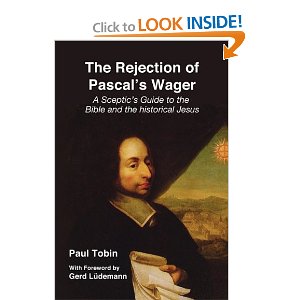
Today I continue my trek through The Christian Delusion: Why Faith Fails (ed. John W. Loftus). Chapter six is by Paul Tobin, the author of The Rejection of Pascal's Wager: A Skeptic's Guide to the Bible and the Historical Jesus (2009). Tobin is a former Christian who decided to investigate the claims of the Bible for himself and his investigation led him to reject his former beliefs. He holds degrees in engineering and business administration and maintains a website, The Rejection of Pascal's Wager, where much of the information in the book was originally published.


His chapter in The Christian Delusion is entitled, "The Bible and Modern Scholarship." He maintains that modern scholarship has shown that the Bible 1) is inconsistent with itself, 2) is not supported by archaeology, 3) contains fairy tales, 4) contains failed prophecies, and 5) contains many forgeries (p. 148).

Tobin gives a few samples of contradictions in the Bible, such as the two diverse creation reports in Genesis 1 and 2, the two accounts of how many animals Noah brought into the ark, one saying that Noah brought one pair of each kind of animal into the ark and another account in which he brings in seven pairs of clean animals, Paul saying that salvation is by faith alone and James saying it's not by faith alone, and so on. Massive books have been written by Christians in an attempt to deal with the discrepancies in the Bible, for example Gleason Archer's New International Encyclopedia of Bible Difficulties (480 pages) and Norman Geisler's Big Book of Bible Difficulties (624 pages), thereby demonstrating how many contradictions there really are in the Christian Scriptures.

Archaeology used to be cited by apologists as "proving" the accuracy of the Bible, but that argument has pretty much disappeared in the last 20 years. The reason is that recent archeological studies have shown that the Hebrew Scriptures have little or no basis in historical fact. Tobin writes: Since the last decade of the twentieth century there is a growing consensus in modern scholarship that the major elements of the Exodus tale (the Israelites living in Egypt for 430 years, the exodus of this large group out of Egypt into Canaan, and the intervening forty years of wandering in the Sinai Peninsula) are also myths, not history (p. 154). This is the conclusion of such leading archaeological scholars as William Dever (Who Were the Early Israelites and Where Did They Come From?, 2003), Eric H. Cline (From Eden to exile: unraveling mysteries of the Bible, 2007), and Israel Finkelstein and Neil Silberman (The Bible Unearthed: Archaeology's New Vision of Ancient Israel and the Origin of Its Sacred Texts, 2002). In addition, there is little archaeological evidence for any of the events recorded in the Hebrew Scriptures until after the time of Solomon. Finkelstein and Silberman write:
If analyzed from a purely archaeological standpoint, Jerusalem, through those intervening centuries--including the time of David and Solomon--was probably never more than a small, relatively poor unfortified hill country town, no larger than three or four acres in size (David and Solomon: In Search of the Bible's Sacred Kings and the Roots of the Western Tradition, 2006, p. 274).
Obviously, if the stories of the Patriarchs, Moses, the Exodus, the Conquest, and everything else up to the time of Solomon has no basis in history, then it must be mythology or legend. Fables are also a part of the Hebrew Scriptures including a talking serpent (Gen. 3) and a talking donkey (Num. 22). Tobin argues that the NT too contains myths or legends including the virgin birth, Herod's slaughter of the babies in Bethlehem, Mary's and Joseph's trip into Egypt, the Roman census, the wisemen, the star of Bethlehem, and so on (pp. 157-63).

"Fulfilled" prophecies have also been cited often by Christian apologists as proof that the Bible is of divine origin. Tobin (pp. 164-65) maintains that the NT writers used their fertile imaginations to draw parallels between the life of Jesus and the OT prophecies (e.g., compare Matt. 2:14-15 with Hosea 11:1-2). The fact that the details of the prophecy could not be understood until after its fulfillment speaks volumes. What good is a prophecy if it is not understood before its fulfillment? Apologists have also frequently cited the prophecies in the book of Daniel as proof of divine inspiration. The fact is, though, as Tobin shows, many of the prophecies in Daniel were written after the event they pretended to predict. They were really "postdictions" instead of "predictions." Most scholars believe that Daniel was written sometime around 165 BCE. The events it "predicts" prior to this time are remarkably accurate but the ones it predicts for later are off the mark. Evidence of this is found in the book of Daniel itself where God allegedly told Daniel "to seal up the book until the end time" (12:4).

Lastly, Tobin discusses the forgeries in the Bible. Modern scholarship agrees that the book of Daniel, the later part of Isaiah (chs. 40-66) and portions of the Psalms are forged. There is also consensus in rejecting Paul as the author of the Pastoral Epistles (1 and 2 Timothy, Titus) and Peter as the author of the second epistle of Peter. In addition, much doubt exists that Colossians, Ephesians, 2 Thessalonians, 1 Peter, James and Jude are authentic. Conservatives, aware that the existence of forged documents in the Bible would be damaging to their insistence that it is from God, have attempted to mitigate this damage in three ways.
The first is to avoid using the word "forgery" at all cost and use abstruse words like "pseudepigraphy" and "pseudynomity" instead. The second step is to claim that the disciples of Paul (or Peter or James or Jude) wrote under their master's name because the letter "was intended as an extension of his thought--an assumption of the great apostle's mantle to continue his work." The final step is to then say that the ancients accepted pseudepigraphy as something normal and would not consider it negatively as we would today (p. 167).
Tobin shows this last point to be false. Greek and Roman authors warned their audience about forgeries written in their names. The famous Greek doctor Galen actually wrote a whole book telling his audience how to distinguish his work from forgeries (p. 168). Paul himself, if he is the real author of 2 Thessalonians, warns that there could be a letter circulating that falsely purports to be from him (2 Thess. 2:2). In addition, Tertullian records that in his day (2nd century CE), a presbyter had been tried and convicted for forging a document (The Acts of Paul) pretending to be from Paul (see Bart Ehrman, Lost Christianities, pp. 31-32).

Though Tobin does not mention it, one of the principles used by those who selected the books to be included in the canon was authenticity. If modern scholarship is right in its conclusions, much of the NT and some of the OT should have never been included. Furthermore, two of the major "proof texts" for the divine inspiration of the Bible, 2 Timothy 3:16 and 2 Peter 1:20-21, would not have been included in the canon thus nullifying their impact on the doctrine of inspiration.

Tobin conclusively shows through the five points made in this chapter that modern scholarship has dealt a death-blow to the idea that the Bible is the Word of God.